TLDR
Two offers land in your inbox: hybrid at $100,000 and on-site at $105,000. Most people grab the bigger number, and that can cost them. Here is what Remote vs Hybrid vs On-Site Jobs in the US actually pay in 2026.
The problem is that the numbers online contradict each other. One 2026 dataset shows a $140,000 median for hybrid roles against $100,000 on-site. A tech study shows remote workers earning $7,703 less than on-site peers in the same jobs.
I sorted through the conflicting figures so you don’t have to. You will see why the gap exists, where location rules cut salaries, and what to ask before you sign. For more benchmarks, browse the latest US salary data too.
Remote vs Hybrid vs On-Site Jobs in the US: What the 2026 Pay Data Says
Start with the largest dataset I could verify. JobsPikr analyzed US job postings published between late June and late September 2026. Among postings that quote an annual salary, the median hybrid role advertised $140,000 and the median remote role $137,800.
The median on-site role advertised $100,000. At the top end, the 90th percentile remote posting reached $264,000.
That looks like a clear win for flexibility. Then you check other studies, and the picture gets messy. Here is how the main 2026 sources compare.
| Source | What it measures | Remote | Hybrid | On-site |
| JobsPikr, US postings (Jun to Sep 2026) | Median advertised salary | $137,800 | $140,000 | $100,000 |
| Ringover, 30 remote-capable jobs | Average advertised salary | $95,158 | $95,018 | $86,305 |
| JobLeads, US tech postings | Pay vs the same role on-site | $7,703 less | About $2,000 less | Baseline |
| JobLeads, entry-level, 1.2M listings | Median salary | $69,860 | $77,020 | $54,900 |
| Acturhire, 612 actuarial roles | Average midpoint of posted range | $126,379 | $134,168 | $146,285 |
Three of these five rows favor flexible work. Two favor the office. That split isn’t an error. It shows how much the answer depends on who ends up in the sample.
Each source counts a different slice of the market. JobsPikr covers every posting with a salary. Ringover looked at 30 remote-capable jobs. JobLeads focused on tech and Acturhire on actuaries. Ringover’s numbers work out to remote workers earning 9.76% more than office workers, which is where that popular headline comes from. It’s a real figure, but it describes 30 jobs, not the whole country.
It also helps to know how rare flexible jobs are. In JobsPikr’s posting data, 78% of roles are fully on-site, 17.1% are hybrid and 4.9% are remote.
Why the Headline Gap Is Mostly a Job Mix Story
JobsPikr is upfront about this. Its report calls the gap a job mix difference, not a flexibility premium. Among on-site postings that state a pay period, 68% quote an hourly rate. Among hybrid postings, only 15% do.
Hourly work tends to be hands-on work, and hands-on work rarely goes remote. So the on-site pile includes cashiers, drivers and line cooks, while the hybrid pile leans toward analysts and managers. Of course the second median looks higher.
A February 2026 working paper from the Federal Reserve Bank of San Francisco backs this up. The authors used French administrative data, so treat it as a signal rather than a US number. They found that remote workers earn 12% more per hour than fully on-site workers in the same occupation, industry and commuting zone.
About half of that premium, roughly six points, disappears once you account for worker traits like education and age, and firm traits like size and productivity. The remaining 6% largely reflects selection. People who work from home after COVID-19 already earned more before it.
In plain terms, most of the premium travels with the type of worker, not the work location. Switching to remote won’t automatically add 12% to your pay.

Remote Pay by Field: Tech, Actuarial and Medtech
The field you work in changes the answer more than almost anything else. Tech is the clearest example.
JobLeads analyzed US tech postings in 2026 and found that remote workers earn $7,703 less on average than on-site workers in the same roles. They report that 86% of tech positions pay less when done remotely. Only six positions, just over 14% of the tech job market, pay more.
Executives are the exception. JobLeads found executive-level roles consistently pay more remotely, by an average of $23,517. That fits what I’d expect at the top of the ladder, where scarce skills matter more than location.
If you are aiming for that level in security, the CISO salary guide shows what the top of that ladder pays. JobLeads also reported hybrid tech roles paying about $2,000 less than on-site.
Actuarial work flips the pattern for a different reason. Acturhire reviewed 612 actuarial roles with disclosed pay. On-site roles averaged a $146,285 midpoint, hybrid $134,168 and remote $126,379. The author points to seniority mix and expensive in-office markets such as New York, Hartford and Chicago.
MDDI’s 2026 medtech salary survey found hybrid workers out-earned both remote and in-office peers. Two recruiters it quoted said the gap says more about who works in each arrangement than where.
In the 2025 to 2026 Salesforce Ben salary survey, office-based workers were also more likely to report a pay increase.
My read: where the work is specialized, scarce and senior, remote can match or beat on-site. Where employers can fill a role locally, the office still pays a little more. City matters too, so check data scientist salary by city before you anchor to a national average.
The Entry-Level Gap: Where On-Site Costs the Most
This is the part most salary comparisons skip. JobLeads looked at more than 1.2 million active US listings, and Forbes reported the results in August 2026.
The median entry-level salary was $77,020 for hybrid roles and $69,860 for remote roles. On-site roles came in at $54,900. That is a $22,120 gap between hybrid and on-site, and remote junior roles still sit 27% above on-site.
There is a catch. Only 9% of on-site listings carried clearly junior titles, compared with 33% of remote listings. Many on-site postings use titles like associate instead. So part of the gap comes from labels, not from different pay for the same work.
Even with that caveat, the direction is hard to ignore. If you are early in your career, a flexible role is not a pay cut. Cybersecurity shows how it plays out. A guide to becoming a cybersecurity analyst without a degree and the wider cybersecurity career path show how titles map to pay at each step.
If you are weighing training before you apply, cloud bootcamp vs degree covers which route pays off faster.
Pay transparency helps here. JobsPikr found that 70% of hybrid and 67% of remote postings include a salary, against 62% of on-site postings.
Geographic Pay: The Line That Can Cancel a Remote Raise
Remote pay isn’t one number if your employer prices by location. This is the detail I’d check before anything else.
A WorldatWork study reported by SHRM found that 67% of employees expect their pay to reflect where they live. Among employers, 41% apply a premium or discount to a job-based pay structure, and 33% build a separate base pay structure for each location. That survey dates from 2021, but Deel’s August 2026 analysis says geographic pay is back and more granular than before.
A 2026 roundup of Payscale data reports that 62% of organizations with remote workers use geographic pay policies, with differentials from 5% to 30%. Take a $120,000 band as an illustration. Depending on your tier, it could land anywhere from $84,000 to $114,000.
Hiring across state lines also triggers state payroll tax registration, according to payroll guides, so some “remote” roles accept candidates from only certain states. Applicant tracking systems can filter on location, so read up on ATS filters in US job applications before you pick the city to list.
Before you accept a remote offer, ask three things:
Real Pay After Costs: A Simple Example
Base salary is the wrong unit for comparing work models. What matters is what you keep.
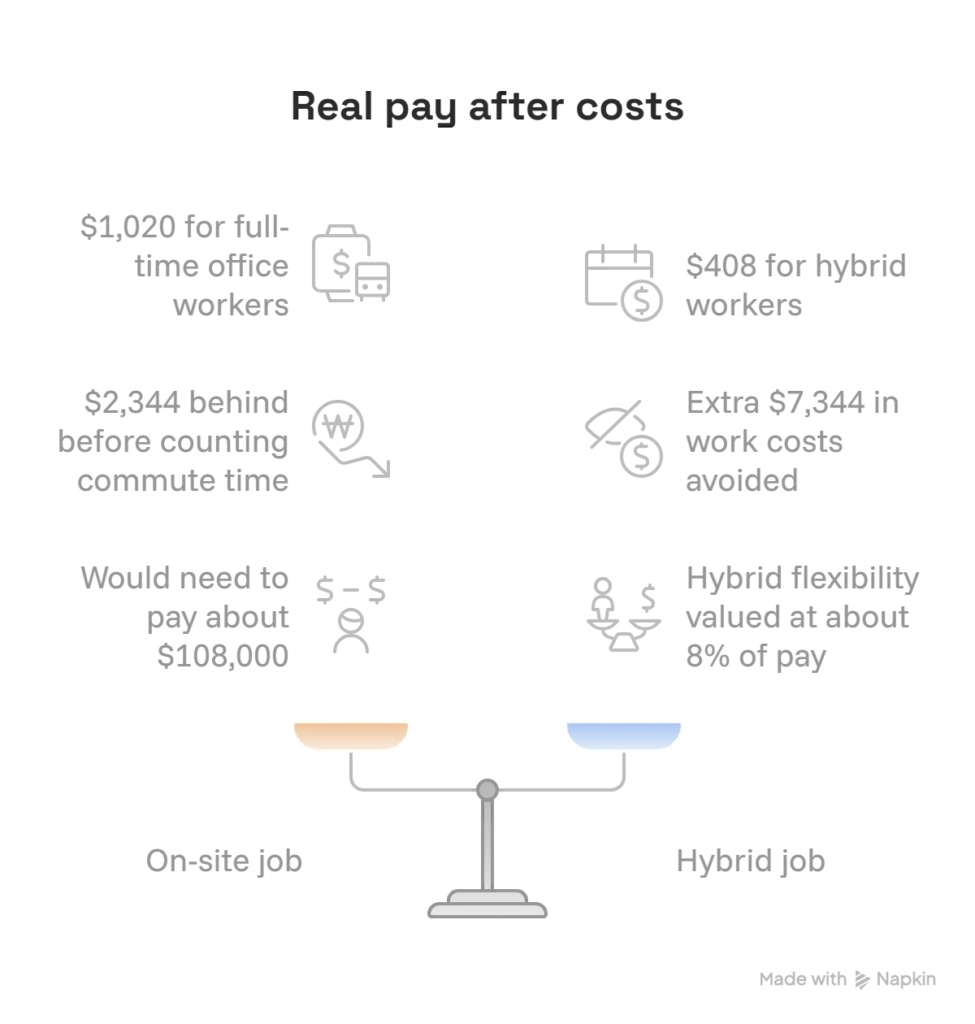
The Interview Guys’ May 2026 analysis puts monthly work-related spending at $1,020 for full-time office workers and $408 for hybrid workers. That is $612 a month, or $7,344 a year. Owl Labs’ 2025 State of Hybrid Work report, as cited in 2026 salary roundups, found workers value hybrid flexibility at about 8% of pay.
Now run it on the two offers from the top. The on-site job pays $5,000 more. Subtract the extra $7,344 in work costs and you are $2,344 behind before counting commute time. Using the 8% figure, the on-site job would need to pay about $108,000 to feel equal.
Taxes and housing can push that number either way, so run your own cost of living math.
How to Negotiate Each Work Model
The approach changes with the arrangement. Always negotiate total compensation, including bonus, equity such as RSUs or stock options, and benefits, not base pay alone.
Remote offer. Ask how location affects pay, then anchor on pay data for your role, not national averages. Some employers have tiers where adjacent bands sit $10,000 to $20,000 apart, so ask whether a tier can move.
Hybrid offer. Get the in-office day count in writing. A band built for two days a week isn’t the same as one built for four.
On-site offer. You are giving up something workers value at roughly 8% of pay. Ask for a commute stipend, parking, extra PTO or a signing bonus.
Pay talk usually starts in the interview loop. Brush up on the US tech interview process, practice behavioral interview questions, and read what to wear and say in a US job interview. Your paperwork matters too, so see what employers want in a US resume vs CV.

Four Pay Myths About Work Models
Myth 1: Remote always pays more. The Ringover and JobsPikr numbers say so, but JobLeads found 86% of tech positions pay less remotely. Pay depends on field and level.
Myth 2: Hybrid always sits in the middle. In JobsPikr’s data, hybrid had the highest median. In JobLeads’ tech data, it paid about $2,000 less than on-site. It sits wherever your field puts it.
Myth 3: On-site jobs are disappearing. In JobsPikr’s posting data, 78% of roles are fully on-site.
Myth 4: Moving to a cheaper city keeps your salary. Not if your employer uses geographic pay. Ask before you sign, not after you move.
Frequently Asked Questions
-
Do remote workers earn more than office workers?
On average across advertised jobs, often yes. Ringover found remote pay 9.76% higher across 30 remote-capable jobs. But the premium depends on field and seniority, and most of the raw gap reflects who works remotely.
-
Do remote jobs pay less than on-site jobs in tech?
In JobLeads’ 2026 study, yes. Remote tech workers earned $7,703 less than on-site workers in the same roles. Executives were the exception.
-
Does hybrid pay more than fully remote?
In JobsPikr’s data, hybrid had a $140,000 median against $137,800 for remote. In tech, hybrid also beat remote on JobLeads’ numbers. Results vary by field.
-
Do remote workers get paid less based on location?
Sometimes. Around 62% of organizations with remote workers use geographic pay policies, per a 2026 roundup of Payscale data. Ask whether pay is set by role or location.
-
How much is remote work worth in salary terms?
Roughly 8% of pay, per Owl Labs’ 2025 report as cited in 2026 roundups. Use it as a negotiating floor, not an exact price.
-
Which work model pays entry-level workers the most?
Hybrid, at a $77,020 median in JobLeads’ 1.2 million listing analysis. Remote came in at $69,860 and on-site at $54,900.
Share Your Experience
I’d like to hear what happened when you negotiated a remote, hybrid or on-site offer. Did a location policy surprise you? Leave a comment with your field, your level and what you learned.
How This Article Was Created
The figures come from JobsPikr’s 2026 Labor Market Insight Report, Federal Reserve Bank of San Francisco Working Paper 2026-02, JobLeads’ tech and entry-level studies (the latter reported by Forbes), Ringover, Acturhire, MDDI, Salesforce Ben, SHRM’s coverage of WorldatWork, Deel, The Interview Guys, and a 2026 compilation of Payscale and Owl Labs data.
I did not fabricate any figures. I checked the key numbers against the original pages where I could reach them. The Levels.fyi, Glassdoor and BLS sites were not used. The WorldatWork survey dates from 2021, and I flagged that where it appears. This article was written to inform job seekers, not to recruit or advertise.

Shahzada Muhammad Ali Qureshi (Leeo)
I’m Shahzada — a software engineer by education and an SEO professional by trade. I built WhatIsTheSalary.com to go beyond just showing salary numbers — every page is manually researched across sources like BLS, Glassdoor, LinkedIn Salary, and PayScale to give you the full picture in one place. If you found what you were looking for here, that’s exactly the point.