TLDR
Your new offer says $92,000. Your current job pays $85,000. Easy yes, right? Not so fast. The 401(k) match drops, the health plan costs $1,800 more, and your bonus shrinks by $2,000.
That is how a raise becomes a pay cut. In Bank of America Institute’s Q1 2026 data, 44% of job switchers saw no raise at all. Knowing How to Switch Jobs Without Losing Salary in the US means comparing total compensation, not just base pay.
In this guide, I will show you how to price a full offer, time your exit around bonuses and vesting, and negotiate without risking the job. For more real salary data by role and city, start on the homepage.
Is Switching Jobs Still Worth It in 2026?
Yes, but the edge is thinner than it used to be. In the year to September 2026, ADP Pay Insights shows job changers got a median base pay rise of 4.8%, against 3.0% for people who stayed. Prices rose 3.7% over the same stretch, so the typical stayer fell behind.
Other trackers tell a similar story with different numbers. The Atlanta Fed Wage Growth Tracker had switchers at 5.0% in August 2026 versus 3.6% for stayers. Bank of America Institute checked its own customer data for Q1 2026 and found switchers’ after-tax and benefit wages grew about 8%, compared with about 5% for stayers.
| Source | Period | Job switchers | Job stayers |
| ADP Pay Insights (median base pay) | Year to Sept 2026 | 4.8% | 3.0% |
| Atlanta Fed Wage Growth Tracker | Aug 2026 | 5.0% | 3.6% |
| Bank of America Institute (after-tax and benefit wages) | Q1 2026, year over year | About 8% | About 5% |
| Bank of America Institute, for comparison | Q1 2022, year over year | Nearly 18% | About 7% |
Why do the numbers differ? ADP counts base pay from payroll records. The Atlanta Fed relies on a worker survey. Bank of America looks at deposits after tax and benefits. None of them is wrong, so I treat the results as a range. A typical switcher gains somewhere between 1.4 and 3 points a year over a stayer.
The trend matters more than any single figure. In 2022, switchers saw pay jump nearly 18% while stayers got about 7%. That gap has shrunk a lot. A September 2026 Bank of America Institute note says the switching premium has climbed to its highest level in more than three years, but it is still below pre-pandemic levels.
A raise is also not guaranteed. In the same Q1 2026 data, 44% of switchers saw no raise at all, or even a cut. So the real goal is not just to switch. It is to switch jobs without losing salary on the way.
Check Your Total Compensation Before You Compare Offers
Base salary is the easiest number to compare and the easiest to get wrong. When I test whether a move makes sense, I put both jobs side by side and count everything:
Here is a made-up example to show how a bigger base can hide a smaller real gain.
| Line item | Current job | New job |
| Base pay | $85,000 | $92,000 |
| Expected bonus | $6,000 | $4,000 |
| 401(k) match (4% vs 2%) | $3,400 | $1,840 |
| Health premiums | -$2,400 | -$4,200 |
| Commute and parking | -$3,000 | -$600 |
| Net total | $89,000 | $93,040 |
Base pay rose 8.2%. The real gain is about 4.5%. The weaker match, the pricier health plan and the smaller bonus ate nearly half the raise, and the hybrid schedule saved the deal. You would never see that from the offer letter headline.
Equity makes this even more important. In senior security roles, KORE1’s 2026 pay guide says equity can add 30% to 50% on top of base at venture-backed and public companies. Our CISO salary guide shows how much of executive pay sits outside the base number.
Time Your Exit Around Bonuses and Vesting
Timing is where many people quietly lose money.
Say your company pays annual bonuses in February and you leave in January. Brooks, quoted by Monster, calls that “cash in your pocket you’d be losing.” Unless the raise is clearly bigger than the bonus, waiting until after payday usually wins.
Check three dates before you resign:
- Your bonus payout date
- Your next vesting date for RSUs or stock options
- The date your 401(k) match vests
If any of them falls within a few months, ask the new employer for a later start date or a signing bonus that covers the gap.
Also, line up the offer before you quit. The BLS quits rate was only 1.9% in August 2026, close to its lowest level since 2020. The New York Fed’s July survey put the average reservation wage at a record $88,387, while workers sounded less sure about landing a new job. Leaving without an offer is a bigger gamble than it was a few years ago. If you do plan a gap, a cash runway of 6 to 12 months is a common recommendation for career changers.

Get Past the Screen So You Have Leverage
You only get real leverage when you have more than one offer. That starts with getting through the first filters. Many US employers sort applications with an applicant tracking system, so read how ATS filters work in US job applications before you send another resume. Also check the difference between a US resume and a CV. Sending the wrong format is an easy way to get ignored.
Once the interviews start, know the road. If you work in tech, this breakdown of the US tech interview process shows what each stage looks like. These behavioral interview questions and answers cover the questions that show up in almost every round. Tone and dress matter more than people admit, so skim what to wear and say in a US job interview before your first call.
My rule is simple. Run at least two live processes at the same time. A second offer is the strongest negotiation tool you have, and it costs nothing.
How to Negotiate Without Losing the Offer
Most pay cuts happen at the negotiation stage, not the application stage. These are the moves I would make:
Do not name your current pay first
Many states ban employers from asking about pay history. Even where it is allowed, you can say, “I’m focused on the range for this role. What is the budget?” Your current salary is your floor, not their anchor.
Use the posted pay range
Many states now require employers to post pay ranges. Aim for the top half of the range for that title, and cross-check it on Glassdoor, LinkedIn Salary and PayScale.
Ask for tradeable pieces when base is locked
NueCareer notes that signing bonuses and six-month performance kickers often move even when base salary will not. Use a signing bonus to replace the bonus you are leaving behind. If equity is on the table, ask for the grant value, the vesting schedule and the latest valuation. Ask for extra PTO or remote days too, and get every promise in writing.
Know what a good raise looks like
Treat the typical switcher gain of about 5% as the minimum. For a lateral move where you lose nothing else, one 2026 analysis suggests asking for 10% or more and adding to that for every benefit you give up. Another puts the realistic range at 7% to 15%. Those are guides, not guarantees, so check them against your own market.
Switching Roles or Industries Without the Pay Cut
Changing fields is where pay cuts hit hardest. People often show up as beginners in a place that cannot see their value yet. The fix is to move sideways first.
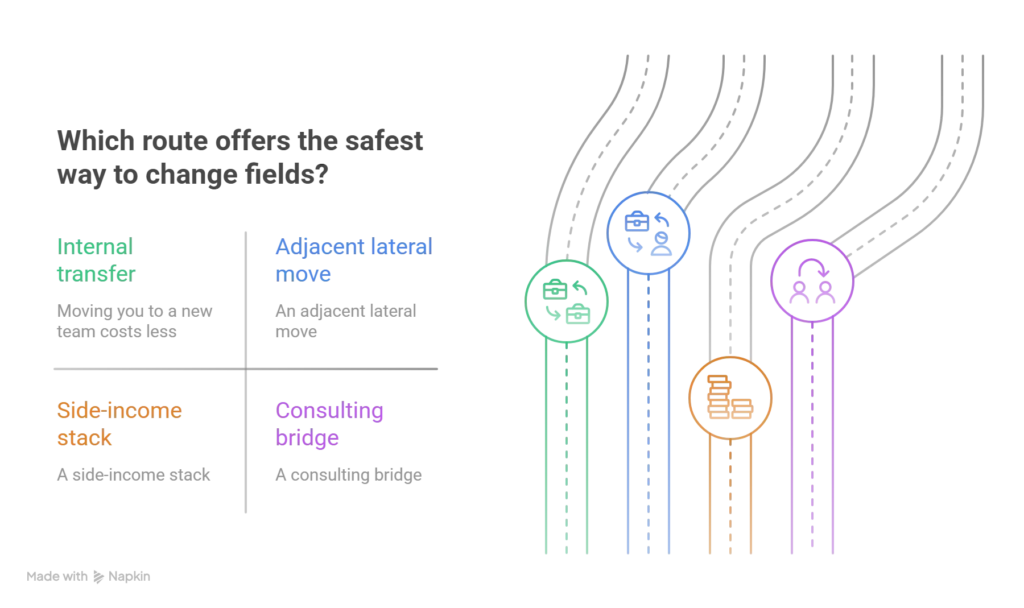
NueCareer ranks the safest routes by speed and salary protection: an internal transfer, an adjacent lateral move, a side-income stack and a consulting bridge. The internal route is cheapest for employers, since moving you to a new team costs less than losing you and hiring from outside.
It is also more common than it sounds. Pew data shows that in a typical month from 2019 to 2021, about 48% of people who changed employers also changed industry, and 60% of US job changers in 2021 and 2022 got raises that beat inflation.
If you are eyeing cybersecurity, our guides on a cybersecurity analyst career without a degree and the full cybersecurity career path show how people enter the field and where the pay goes from there.
Location moves the number too. Zippia’s regional breakdown, based on 2021 figures, had switchers in the Northeast averaging 8.8% raises and the West 8%, against 5.6% in the South and 3% in the Midwest. Those numbers are dated, so use them for the gap, not the exact percentage. For city-level pay in one field, see our data scientist salary by city breakdown.
Who Gains the Most From Switching, and Who Does Not
Age and pay level change the math. Bank of America’s Q1 2026 data shows Gen Z switchers saw more than four times the wage growth of Gen Z stayers, even though hopper raises for that group have fallen about 20% since Q1 2022. Lower-wage workers still see the biggest gains from moving.
At the top end the story flips. A Fortune report on the same data found top earners who stay in their jobs get much larger pay increases than top earners who switch.
Korn Ferry’s pulse survey of more than 4,250 organizations puts the median US base salary increase at 3% in 2026, with fewer employees eligible than last year. So if you are underpaid against the market, switching probably pays. If you are already well paid at a good employer, ask for a market adjustment before you start applying.
Is This Move Worth It? A Quick Checklist
- Is my total compensation at the new job higher, not just the base?
- Does the raise beat the bonus, match or equity I would leave behind?
- Have I checked the health plan, premiums and deductible?
- Is the pay range for this title posted, and am I in the top half?
- Do I have an offer in writing before I resign?
- Is my start date after my bonus payout and next vesting date?
If you can answer yes to most of these, you are in good shape to switch jobs without losing salary. If not, keep negotiating or keep looking.

Frequently Asked Questions
-
Can you change jobs without taking a pay cut?
Yes. Compare total compensation, time your exit after bonus and vesting dates, and negotiate with posted pay ranges. Ask for a signing bonus or equity if the base will not move.
-
What is a typical salary increase when switching jobs in 2026?
ADP reports a 4.8% median base pay rise for job changers in the year to September 2026, and the Atlanta Fed reports 5.0% for August. Bank of America Institute shows about 8% after tax and benefits for Q1 2026.
-
Is it worth changing jobs for more money?
It can be, but the average gain over staying is now small, roughly 1.4 to 3 points a year. It makes the most sense if you are underpaid, early in your career or stuck without a path up.
-
When is the best time to switch jobs?
After your annual bonus is paid and your next vesting date has passed, and with a signed offer in hand. Leaving just before either can cancel out the raise.
-
How do I change careers without losing my salary?
Move sideways first. An internal transfer or an adjacent role keeps more of your pay than a jump into a new field, and a bridge such as consulting can cover the gap while you build credibility.
-
Should I tell a recruiter my current salary?
I would not. Many states ban pay history questions, and your number can anchor the offer low. Ask for the budget for the role and share your target range instead.
Share Your Experience
Did you switch jobs this year? I would like to hear how it went. Tell us in the comments what you asked for, what you got, and what surprised you in the offer. Your story might save someone else a few thousand dollars.
How This Article Was Created
This article draws on pay data published in 2026 by ADP Pay Insights, the Federal Reserve Bank of Atlanta, Bank of America Institute, the Bureau of Labor Statistics, the Federal Reserve Bank of New York, Korn Ferry and KORE1, plus Pew Research and Zippia for older context. The reporting covers roughly February to October 2026.
I read these sources through published reports and coverage, not the raw datasets. I did not invent any figure. The only made-up numbers are in Table 2, which is labeled as an illustration. This article is written to inform job seekers, not to recruit or advertise.

Shahzada Muhammad Ali Qureshi (Leeo)
I’m Shahzada — a software engineer by education and an SEO professional by trade. I built WhatIsTheSalary.com to go beyond just showing salary numbers — every page is manually researched across sources like BLS, Glassdoor, LinkedIn Salary, and PayScale to give you the full picture in one place. If you found what you were looking for here, that’s exactly the point.