TLDR
How Long Does It Take to Become a Cloud Architect in the US? For years, the popular advice was simple: collect cloud certifications, apply, and wait for the title. Plenty of engineers followed it, then heard the same reply in every interview: “we need someone who has owned a design.”
The problem is that most guides stop at “it depends.” That leaves you guessing, while Google and AWS both recommend two to three years of hands-on work before their architect exams even make sense.
My fix is a realistic timeline for four starting points, with pay at every stage and one simple idea: own real design decisions on a single cloud. I built it from 2026 data from BLS, Glassdoor, and Salary.com. If you want to compare other careers too, browse real salary data across hundreds of jobs on WhatIsTheSalary.
How Long Does It Take to Become a Cloud Architect? The Short Answer
The honest range is five to ten years from your first technical job. Futurense’s 2026 guide lands on five to ten years, and our cloud architect career guide puts it at five to eight years of progressive cloud experience. The title follows ownership of design decisions, not a date on the calendar.
The certification providers back this up. Google recommends three or more years of industry experience, including one year of designing on Google Cloud, before its Professional Cloud Architect exam. AWS recommends two or more years of hands-on work before its Solutions Architect Professional exam. Neither one expects a beginner.
Real people report the same spread. In a Red Hat community poll, 107 readers answered how long it took them to reach an architect title. Fifty said under seven years. Forty-four said seven years or more. It is an informal poll, but it shows why one number never fits everyone. Treat five to ten years as a map, not a deadline.
You will also see sites promise results in months. You can learn the concepts in months. You cannot earn the judgment that comes from running a system that breaks at 2 a.m. in months.

Cloud Architect Timeline by Starting Point
These four paths are my estimates, built from the certification requirements and sources above. They are not a published statistic, so use them as a planning range.
From a cloud or DevOps engineer role: two to four more years
You already run production workloads, so your gap is design ownership. Lead one migration or new build from requirements to launch, write down your tradeoffs, and earn the Associate and then the Professional certification on your main platform. AWS recommends two years of hands-on work for the Professional exam, so this path fits inside that window.
From a software developer: four to seven years in total
Developers know application constraints but often lack networking, identity, and cost experience. Spend one to two years going deep on one cloud, then move into a platform or infrastructure role where you own the designs.
From IT support or system administration: six to nine years
Your operations instincts are an asset. The climb is moving from tickets to code, learning infrastructure as code with Terraform or CloudFormation, and landing a cloud engineer job first. That single step can take one to three years.
From outside tech: eight years or more
You need an entry job first, then the engineering years, then design ownership. A bootcamp or degree can speed up that first job, but no program removes the production years. Be skeptical of anyone promising less.
What You Earn While You Become a Cloud Architect
You do not wait ten years for a raise. Pay climbs at every stage, and the table below shows the 2026 benchmark ranges I found.
Cloud architect pay by experience stage (US, 2026)
| Stage and years | Typical title | US pay benchmark |
| Early, 0 to 3 years | Cloud, systems, or DevOps engineer | $110,000 to $150,000 total comp |
| Mid, 3 to 6 years | Senior engineer or associate architect | $150,000 to $190,000 total comp |
| Architect, 7 to 10 years | Cloud architect | $155,000 to $200,000 base; $175,000 to $240,000 total comp |
| Senior, 10 to 14 years | Senior cloud architect | $190,000 to $235,000 base; $225,000 to $310,000 total comp |
| Principal, 14 plus years | Principal or lead architect | $220,000 to $275,000 base; $270,000 to $410,000 and up total comp |
Different sources report very different averages, and that confuses people. Salary.com lists an average of $124,149 as of July 1, 2026. Glassdoor shows $202,599 in average total pay from 1,422 submissions, with the 90th percentile at $324,847. Levels.fyi, which skews toward companies that pay heavily in stock, reports a median total compensation of roughly $220,000 to $226,000.
The gap of about $78,000 between Salary.com and Glassdoor comes down to who reports. Glassdoor and Levels.fyi rely on self-reported pay that includes bonuses and RSUs, and they lean toward larger employers. Broader datasets include more junior titles and base pay only.
For an official anchor, BLS has no separate cloud architect line, so I use computer network architects as the nearest category. The median was $134,050 in May 2025. BLS projects 8 percent growth from 2025 to 2035, with about 9,600 openings a year.
Location moves the number too. BLS state medians for network architects run from $127,320 in North Carolina to $140,390 in New York, $158,870 in California, and $168,070 in Washington. If you want to see how city pay shifts in a neighboring tech role, our data scientist salary by city breakdown is a useful comparison.
Do You Need a Degree to Become a Cloud Architect?
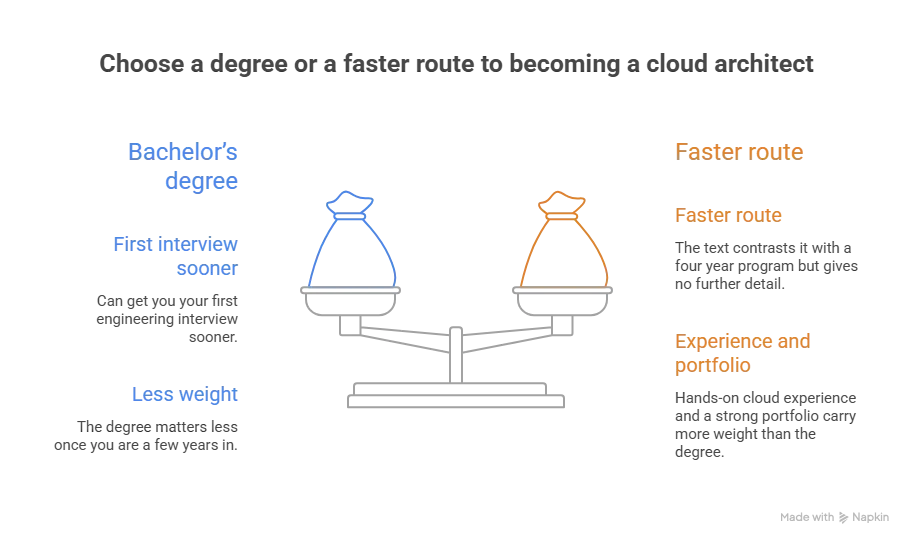
No, but a degree changes where you start. edX puts a bachelor’s degree in IT at four to six years, and many job posts still list one as preferred. A degree can get you your first engineering interview sooner. It does not shorten the years of production work that earn the architect title.
If you are choosing between a four year program and a faster route, our cloud bootcamp vs degree comparison lays out the tradeoffs. The same skills-first logic applies in adjacent fields, and our guide to becoming a cybersecurity analyst without a degree covers that route.
Futurense’s 2026 guide says hands-on cloud experience and a strong portfolio carry more weight than the degree once you are a few years in. That matches what the certification providers ask for: years of doing, not years of studying.
The Certification Clock: What Each Exam Expects
Certifications will not make you an architect, but they set a floor for timing. Here is what each provider recommends before you sit the exam.
Cloud architect certifications compared (US, 2026)
| Certification | Recommended experience | Exam fee (USD) |
| AWS Solutions Architect Associate | 1 or more years designing on AWS | $150 |
| AWS Solutions Architect Professional | 2 or more years designing AWS solutions | $300 |
| Google Professional Cloud Architect | 3 or more years in industry, including 1 on Google Cloud | $200 |
| Azure Solutions Architect Expert (AZ-305) | Advanced IT operations experience; AZ-104 first | $165 (AZ-104 is also $165) |
Add it up and the exams cost well under $500 in total. The real price is time. AWS also gives you 50 percent off your next exam after you earn one certification, which makes the Associate then Professional route cheaper. Do not book the Professional exam early just to feel productive, because a failed attempt costs $300 and a few months of momentum.
Pick one platform and match it to the job market you want. Our breakdown of AWS certifications that boost salary covers the Amazon side, and Azure certifications that boost salary in the US covers Microsoft.
Skills That Shorten the Path
Skills decide whether you finish in five years or ten. Four matter most.
Security is a strong specialization. If it appeals to you, our cybersecurity career path guide maps the roles around it, and architects who know compliance frameworks such as SOC 2, HIPAA, or FedRAMP stand out in hiring.
Signs You Are Ready for the Architect Title
If you can check four of five, start applying. Waiting for a perfect résumé is how people add a year they do not need.
Mistakes That Add Years
Collecting certifications instead of decisions. A dozen exam badges do not replace one design you can defend.
Learning three clouds at once. Depth on AWS, Azure, or Google Cloud builds judgment faster than shallow exposure to all three.
Skipping the engineer years. Jumping from junior developer to architect usually produces designs that fail in production.
Chasing the title instead of the scope. Many postings labeled cloud architect are senior engineering jobs with little design authority. Ask who makes the final architecture call before you accept.
Waiting for permission. Take design ownership on a small project and record each choice in an architecture decision record.
How AI Is Changing the Timeline in 2026
Several 2026 career guides, including Futurense’s, say employers now expect architects to design for AI and machine learning workloads and to understand AIOps, which uses automation for monitoring and incident response.
I would not treat that as a reason to wait. I would add one project that runs a model on your chosen cloud while you build the core skills. That gives your portfolio a 2026 edge without adding years.

Where the Path Goes After Architect
Senior and principal roles stretch the same pay table further. Management is another branch: BLS reports a $175,140 median for computer and information systems managers in May 2025, with 16 percent projected growth from 2025 to 2035. If security leadership appeals to you, our CISO salary guide shows what that road pays.
Frequently Asked Questions
How many years of experience do you need to become a cloud architect?
Most cloud architects have five to ten years in engineering, DevOps, or cloud infrastructure. Google recommends three or more years of industry experience for its architect exam, and AWS recommends two or more for its Professional exam. The title depends on design ownership more than on years.
Can you become a cloud architect in two years?
It is rare. A working cloud engineer who already owns production systems can sometimes reach an architect role in two to four more years. Starting from zero, two years usually covers only your first engineering job.
Which certification should I earn first?
Pick the platform your target employers use. The AWS Solutions Architect Associate is the common starting point, Azure suits Microsoft-heavy enterprises, and Google’s Professional Cloud Architect fits teams on Google Cloud. Earn one, then build projects before adding another.
Is cloud architect a good career in 2026?
Yes. BLS projects 8 percent growth for computer network architects from 2025 to 2035, and 2026 data from Glassdoor and Salary.com shows six-figure averages. The catch is the long ramp, because this is not an entry-level job.
Do cloud architects need to code?
Not the way software engineers do. Most write infrastructure as code, scripts, and some automation, but deep application development is uncommon. You still need enough coding skill to review and defend a design.
Share Your Experience
If you made the jump from engineer to architect, I would love to hear how long it really took you. Tell me your starting role, the certification you earned, and what finally got you the title. Your timeline might save someone else a year.
How This Article Was Created
I built this article from public data published in 2026. Official figures come from the Bureau of Labor Statistics (May 2025 wage data and 2025 to 2035 projections), the AWS and Google Cloud certification pages, Glassdoor, and Salary.com. Azure exam fees come from training provider listings, and the Levels.fyi, Futurense, and KORE1 numbers come from 2026 salary guides that cite them, so check the live pages before you quote them elsewhere.
The Red Hat poll is informal. The timelines by starting point are my own estimates, and the article labels them that way. I did not invent any salary figure. I wrote this to help job seekers plan their careers, not to recruit or advertise.

Shahzada Muhammad Ali Qureshi (Leeo)
I’m Shahzada — a software engineer by education and an SEO professional by trade. I built WhatIsTheSalary.com to go beyond just showing salary numbers — every page is manually researched across sources like BLS, Glassdoor, LinkedIn Salary, and PayScale to give you the full picture in one place. If you found what you were looking for here, that’s exactly the point.