TLDR
Bootcamp vs Degree for Software Engineering in Australia: What Actually Works in 2026? Deciding between an intensive bootcamp and a traditional degree can feel like choosing between speed and credibility—especially now, when employers weigh practical skills, AI literacy, and proven project outcomes more than ever.
Here’s the short truth: bootcamps fast-track hands-on coding, real-world projects, and job-ready portfolios in months; degrees offer deep theory, accreditation, and broader career options over years. Which wins depends on your timeline, learning style, and target employers—startups and product teams often favor demonstrable skills; government, research, and senior engineering roles still lean on degrees.
If you want rapid job entry with focused skill-building, pick a reputable bootcamp with employer partnerships and mentorship. If you aim for long-term resilience, leadership, or niche fields (AI, embedded systems), a degree paired with internships is safer.
The Question Every Aspiring Developer in Australia Is Asking Right Now
I get it. You are sitting there trying to decide between spending three to four years on a Bachelor of Computer Science or Bachelor of Software Engineering at a university, or spending a few months and a fraction of the cost at a coding bootcamp in Australia. Both paths promise a job at the end. Both come with trade-offs that nobody seems to spell out clearly.
So let me give you an honest breakdown, using real 2026 data from sources like SEEK, Glassdoor, and Levels.fyi, without the marketing spin.

The Numbers Side by Side: Cost, Time, and What You Actually Earn
Before you commit to either path, you need to see the real comparison in one place. Here is what the 2026 market looks like in Australia.
| Factor | Coding Bootcamp | CS / Software Engineering Degree |
| Duration | 3 to 6 months | 3 to 4 years (full-time) |
| Cost (AUD) | $10,000 to $20,000 | $30,000 to $50,000+ (domestic); $80,000+ (international) |
| Entry-Level Salary | $70,000 to $90,000 | $74,000 to $95,000 |
| Mid-Level Salary | $90,000 to $120,000 | $100,000 to $140,000 |
| Senior Salary | $130,000 to $160,000 | $150,000 to $190,000+ |
| ACS Accreditation | Not eligible | Eligible (ANZSCO 261313) |
| Job Placement Rate | 79% to 93% (top programs) | ~85% within 12 months of graduation |
| Time to First Job | 3 to 6 months post-bootcamp | 3 to 6 months post-graduation |
| Skills Focus | React, Node.js, Python, AWS | Algorithms, data structures, systems, software engineering principles |
| Best For | Career changers, fast entry | Long-term growth, senior/leadership roles, research |
The Coding Bootcamp Path in Australia: Fast, Practical, and Riskier Than It Sounds
A coding bootcamp in Australia is designed to get you job-ready in months, not years. Programs like General Assembly, Le Wagon, Coder Academy, and Hatch Academy (Melbourne) offer full-stack software engineering tracks ranging from AUD $10,000 to $20,000.
Some programs like Hatch Academy use an Income Share Agreement model, meaning you pay only after you land a job. That removes a big financial barrier, especially for career changers switching from healthcare, education, or finance.
What Bootcamps Teach and What They Skip
Bootcamp curricula in 2026 focus on practical, employer-ready skills. Most cover HTML, CSS, JavaScript, React, Node.js, Python, MongoDB, and Git/GitHub. Some programs now include AWS cloud fundamentals and AI-adjacent tools, which is smart given market demand.
What bootcamps generally skip: deep computer science theory, algorithms and data structures at a research level, operating systems, and the kind of systems programming that comes up in senior architecture roles. This is not a deal-breaker for most entry-level roles, but it can become one when you are trying to move into a Staff Engineer or Principal Software Engineer position five years later.
Bootcamp Employment Outcomes in Australia
Based on verified 2025 outcome data, 79% of Australian bootcamp graduates land relevant tech roles, with an average 56% salary increase from their previous career. Top programs like UTS Data Science and AI Bootcamp report a 93% job success rate within 180 days.
The variance is wide, though. Some programs report only 10 to 15% placement. The safest move is to verify a bootcamp’s CIRR-compliant outcomes report before enrolling. If they cannot produce one, walk away.
The Degree Path: Bachelor of Software Engineering and Computer Science in Australia
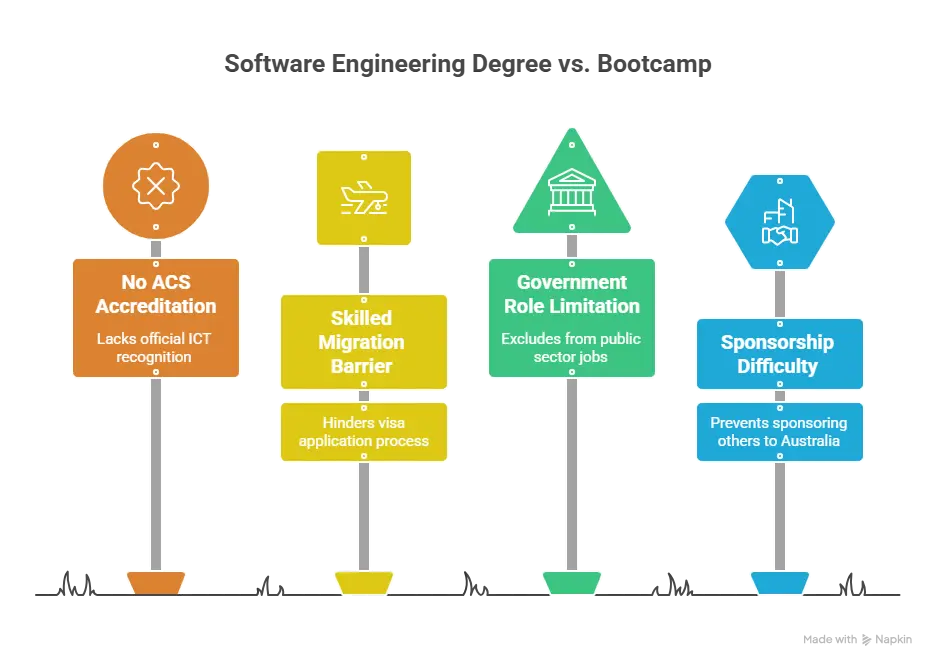
A Bachelor of Software Engineering Australia or a Bachelor of Computer Science Australia gives you something a bootcamp certificate cannot: ACS accreditation. The Australian Computer Society is the official accrediting body for ICT degree programs in the country, and an ACS-accredited degree matters most if you are targeting skilled migration, government roles, or eventually want to sponsor others into Australia.
Universities like ANU, UNSW, University of Melbourne, and University of Sydney offer ACS and Engineers Australia accredited programs. Graduates from these programs start at AUD $74,000 to $95,000 depending on the city, with Sydney graduates at top firms like Atlassian and Canva pushing $85,000 to $95,000 in their first year.
Online and Flexible Degree Options
Not everyone can do full-time on-campus study. Open Universities Australia aggregates online degree programs from multiple providers, including an Online Degree Software Engineering Australia pathway that lets you study part-time around work. A Master of Information Technology Australia or a Graduate Diploma of Information Technology are also popular for people who already hold a degree in another field and want to transition into tech without starting from scratch.
The Diploma of Information Technology Australia and Advanced Diploma of Technology Australia sit below degree level but carry TAFE-recognized credentials that can open doors to junior developer roles and serve as a pathway into a full bachelor’s program.
Salary by Experience Level: What Both Paths Actually Pay in 2026
The salary gap between bootcamp graduates and degree holders tends to close by the time you hit mid-level. Here is what the data shows.
| Experience Level | Bootcamp Graduate (AUD) | Degree Graduate (AUD) | Source |
| Entry-Level (0-2 yrs) | $70,000 to $85,000 | $74,000 to $95,000 | SEEK, Glassdoor 2026 |
| Junior (2-3 yrs) | $85,000 to $100,000 | $90,000 to $110,000 | Indeed, Glassdoor |
| Mid-Level (3-6 yrs) | $100,000 to $125,000 | $110,000 to $140,000 | Levels.fyi, SEEK |
| Senior (7+ yrs) | $130,000 to $160,000 | $150,000 to $190,000 | Glassdoor, Levels.fyi |
| Lead / Principal | $160,000 to $180,000 | $180,000 to $220,000+ | Levels.fyi Australia |
The entry-level gap is roughly AUD $5,000 to $10,000 in favor of degree graduates. By mid-level, what separates salaries is no longer the credential but your portfolio, your cloud certifications, and whether you have shipped production code that solves real problems.
What Australian Tech Employers Actually Look For in 2026
This is the section most comparison articles skip, and it is probably the most important one.
Large enterprises, government agencies, and regulated sectors in Australia, including banking, healthcare, and defense, still use a formal degree as a filter in their ATS systems. If you want to work at NAB, Telstra, or in a Canberra public service tech role, a Bachelor of Computer Science or ACS-accredited degree will almost always get you further than a bootcamp certificate.
Startups, scale-ups, and mid-sized tech companies care less about credentials and more about what is in your GitHub. A strong portfolio of full-stack projects, demonstrated experience with React, Python, and cloud infrastructure, and the ability to pass a technical interview will get you hired regardless of whether your background is a bootcamp or a degree.
The Role of Cloud Certifications
In 2026, cloud certifications have become a genuine differentiator for both paths. AWS Certified Developer Australia, Microsoft Azure Developer Certification, and Google Professional Cloud Developer Certification are recognized by employers across the board. Bootcamp graduates who add one of these certifications right after graduation close much of the credibility gap with degree holders at the entry level.
If you come from a bootcamp and you do not have at least one cloud certification, you are competing on portfolio alone. Add one, and you are suddenly competitive in a much wider range of job listings on Seek.com.au.
If You Are Switching Careers Into Software Engineering in Australia
Career change to software engineering Australia is one of the top search intents around this topic, and for good reason. Australia is projected to add 1.2 million tech jobs by 2030 according to industry forecasts, and many of those will be filled by people who did not start in tech.
For career changers, the bootcamp vs degree math looks different. If you are 32 years old, giving up three to four years of income to do a full-time Bachelor of Software Engineering does not make financial sense for most people. A six-month coding bootcamp followed by a self-taught grind on data structures, algorithms, and AWS certifications is often the faster and cheaper path to a junior developer role.
That said, if your target is a senior technical role at a large company or eventual migration to Australia on a skilled visa, the degree holds its value. The ACS Skills Assessment for Software Engineers (ANZSCO 261313) requires either an ACS-accredited degree or several years of verified work experience. A bootcamp certificate alone will not qualify you for the migration pathway.
International Students and Visa Considerations
For international students, the picture is different again. A bachelor degree from an ACS-accredited Australian university carries weight with Immigration authorities for skilled migration pathways. IELTS or TOEFL requirements apply to both university and some bootcamp programs, though bootcamps generally have lower English proficiency barriers.
If Australian permanent residency is part of your long-term plan, the investment in a Bachelor of Software Engineering or Bachelor of Computer Science is harder to argue against, even with the higher cost and longer timeline.
The Self-Taught Software Engineer Path in Australia: Real Talk
Plenty of working engineers in Australia are self-taught. It is possible. But the self-taught path requires something most people underestimate: extreme self-discipline with a structured curriculum, a very strong portfolio, and usually a lower starting salary while you build credibility.
The self-taught route works best as a complement to either a bootcamp or a degree, not as a standalone alternative. Use it to fill gaps, build side projects, and earn cloud certifications. Use it alongside Open Universities Australia or part-time online study if a full degree is your goal.
Reddit’s r/cscareerquestionsOCE community is a useful, unfiltered source of real career advice from Australian engineers at all stages. The conversations there reflect what hiring managers actually think, not what bootcamp marketing materials say.
Resume Credibility: Degree vs Bootcamp in the Australian Job Market
Here is an honest breakdown of how credentials land on a recruiter’s desk in Australia.
A Bachelor of Computer Science from a Go8 university (University of Melbourne, UNSW, ANU, etc.) is the highest-credibility signal you can have as an entry-level candidate. It tells a recruiter you completed four years of academically rigorous work, you understand the fundamentals, and you have been tested by people who care about computer science theory.

A coding bootcamp certificate from a recognized program like General Assembly or Coder Academy tells a recruiter you learned practical skills quickly and that you are motivated. It signals hustle more than depth. That is not a bad signal, but you need a strong portfolio to back it up.
By the time you have two or three years of industry experience, the credential on your resume matters far less than your GitHub, your technical references, and your ability to perform in a coding interview. The credential opens doors early. After that, what you build is what keeps them open.
Top Coding Bootcamps in Australia and What They Cost in 2026
| Bootcamp | Focus | Cost (AUD) | Format | Notable Feature |
| General Assembly | Software Engineering, Data Science | $15,500 to $16,450+ | Online & In-Person | Strong employer brand recognition |
| Le Wagon | Full-Stack Web Dev, Data Science | $14,000 to $15,000 | In-Person (Sydney, Melbourne) | Global alumni network |
| Coder Academy | Full-Stack Development | $10,000 to $13,000 | Online & Campus | 79% job placement rate |
| Hatch Academy (Melbourne) | Software Engineering | ISA model (pay after hiring) | Campus | Income Share Agreement option |
| UTS Bootcamp | Data Science & AI | ~$15,000 | Online | 93% job success within 180 days |
| Institute of Data | Data Science, Cyber, Software | $12,000 to $17,000 | Online & In-Person | TAFE and university partnerships |
Which Path Should You Actually Take? A Decision Framework
Stop trying to find the universally correct answer. There is not one. Here is how to make the decision based on your situation.
Choose a Coding Bootcamp If:

Choose a Degree (Bachelor of Software Engineering or Computer Science) If:
Frequently Asked Questions
-
Is a coding bootcamp enough to get a software engineering job in Australia?
Yes, for many roles. Top Australian bootcamps report 79% to 93% employment rates. However, the quality varies widely between programs. Check for verified outcome reports, industry connections, and career support services before enrolling. A cloud certification like AWS Certified Developer alongside your bootcamp certificate significantly improves your chances.
-
What is the average software engineer salary in Australia in 2026?
According to SEEK and Glassdoor data from early 2026, the average software engineer salary in Australia sits between AUD $105,000 and $130,000 per year. Entry-level roles start around AUD $70,000 to $90,000, while senior engineers can earn AUD $150,000 to $190,000 and above.
-
Do I need a degree for ACS Skills Assessment in Australia?
An ACS-accredited degree makes the skills assessment process straightforward. Without one, you need several years of verified, relevant work experience to qualify under the ICT occupation codes (ANZSCO 261313 for Software Engineer). A bootcamp certificate alone does not satisfy the ACS Migration Skills Assessment requirements.
-
How long does it take to become a software engineer in Australia?
Via a coding bootcamp, you can be job-ready in 3 to 6 months. Via a Bachelor of Software Engineering or Bachelor of Computer Science, it takes 3 to 4 years full-time. An online or part-time degree through Open Universities Australia can stretch to 5 to 6 years depending on your pace.
-
Are bootcamp graduates paid less than degree graduates in Australia?
At entry level, degree graduates typically earn AUD $5,000 to $10,000 more per year. By mid-level (3 to 6 years experience), the gap narrows significantly and portfolio quality, cloud certifications, and specializations like full-stack development or cloud engineering matter more than the original credential.
-
What certifications help software engineers in Australia?
The most in-demand certifications in 2026 are AWS Certified Developer, Microsoft Azure Developer Associate, and Google Professional Cloud Developer. These are recognized by employers across all company sizes and are particularly valuable for bootcamp graduates looking to close the credibility gap with degree holders.
-
Can I study software engineering online in Australia?
Yes. Open Universities Australia and individual universities like Deakin and Charles Sturt offer accredited Online Degree Software Engineering programs. These work well for part-time students and career changers who need to keep earning while studying. Just confirm the program carries ACS accreditation if your goal includes skilled migration.
Share Your Experience
Have you gone through a coding bootcamp or completed a software engineering degree in Australia? I would genuinely like to hear how it played out for you. What salary did you land first? Did the credential matter as much as you expected? Drop your experience in the comments below. Real data from real people is what makes these guides actually useful.
How This Article Was Created
All salary data in this article comes from publicly reported figures on SEEK (early 2026 data), Glassdoor (April 2026, based on 15,307 anonymous submissions), Levels.fyi (June 2026, A$114,645 to A$188,270 range), and ERI SalaryExpert (2026 Australia dataset). No salary figures were fabricated. Employment outcome statistics for bootcamps are drawn from verified provider reports and Course Report 2025 data. This article was written to inform people making genuine career decisions, not to promote any specific program or employer.

Shahzada Muhammad Ali Qureshi (Leeo)
I’m Shahzada — a software engineer by education and an SEO professional by trade. I built WhatIsTheSalary.com to go beyond just showing salary numbers — every page is manually researched across sources like BLS, Glassdoor, LinkedIn Salary, and PayScale to give you the full picture in one place. If you found what you were looking for here, that’s exactly the point.