TL;DR
Junior Software Engineer Jobs Australia are opening doors for fresh talent, but most candidates still miss out because their resume and profile fail to match what employers actually want.
The real problem is not lack of skill. It is weak positioning, vague project descriptions, and no clear proof that you can build, debug, and ship real work. That is where a strong AIDA based introduction changes everything.
Use a hook that grabs attention, shows the pain, and presents the solution fast. Highlight your coding stack, internship or project wins, and eagerness to grow. That simple shift can turn a silent application into one that gets noticed.
The Market Has Shifted, And Most Graduates Are Not Prepared For It
If you finished your computer science or software engineering degree in 2024 or 2025 and have been struggling to get interviews, you are not imagining things. The entry-level job market in Australia has tightened in a way that caught a lot of graduates off guard.
Three or four years ago, companies were hiring aggressively. Graduate programs filled up. Internships converted into full-time roles. Junior developers could find work at agencies, consultancies, and startups without needing much more than a solid degree and a few personal projects.
That version of the market is mostly gone now. What replaced it is more selective, more competitive, and far less forgiving of candidates who look like everyone else.
This article breaks down the specific reasons why junior software engineering jobs are harder to get in Australia right now, what the data shows, and what actually helps candidates who are still landing roles.
Reason 1: AI Is Reducing Demand for Entry-Level Coding Work
This is the most significant structural shift. AI coding assistants, particularly GitHub Copilot, are now used across most mid-to-large Australian tech teams. The efficiency gains are real and documented.
Australian software company ReadyTech told the government’s Jobs and Skills Australia (JSA) in their Generative AI Capacity Study that AI-assisted coding had improved team efficiency by over 25%, along with reduced time spent on debugging and rework. The downstream effect of that efficiency gain was direct: ReadyTech reduced its junior developer headcount and moved to hiring more experienced engineers instead.
The senior leader quoted in the JSA study put it plainly: there was no logical business reason to take on a junior engineer and train them up the same way they previously had.
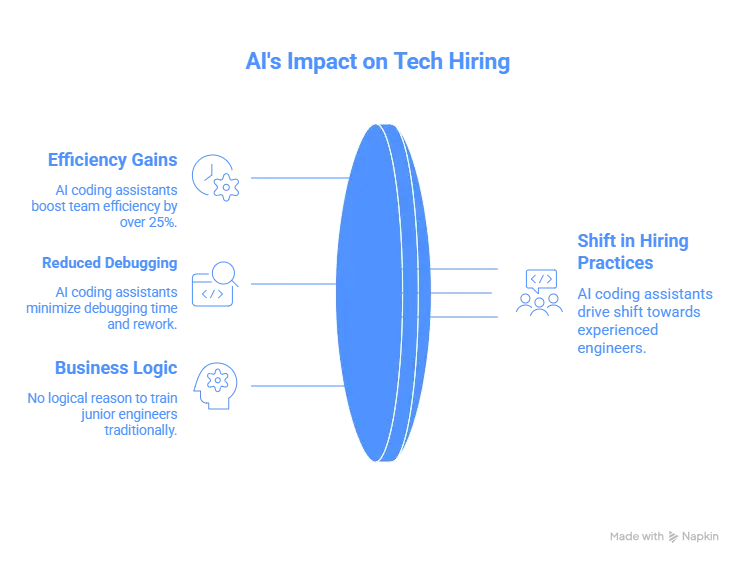
That is one company, but it reflects a broader pattern. When a senior engineer using AI can produce what previously required two or three junior developers, the math on junior hiring changes.
The kinds of tasks most affected are exactly the ones that used to define junior roles: writing boilerplate code, debugging simple logic errors, writing test scripts, and making incremental changes to existing code bases. These are also the tasks that matter most when you are learning. If they are automated, it is harder for junior hires to demonstrate value quickly, and it is harder for companies to justify the mentorship overhead. For more on entry-level software engineer pay expectations, see our junior software engineer salary guide for Australia.
Reason 2: Hiring Is Now Precision-Led, Not Expansion-Led
Between 2020 and 2022, Australian tech companies were in expansion mode. Teams were growing fast, remote work opened up hiring across cities, and companies were adding headcount to keep up with digital transformation timelines that were accelerated by COVID.
That period is over. According to Fuse Recruitment, a specialist Australian tech recruiter, hiring in 2026 is precision-led. Companies are recruiting fewer people, but they want greater impact from each hire. Technical competency is assumed. What differentiates candidates now is relevance, commercial awareness, and communication.
That language, relevance and commercial awareness, is not something most university courses teach. A junior developer coming out of a degree program typically has strong theoretical knowledge and some project experience, but limited understanding of how a software product actually creates business value.
When hiring is precision-led and budgets are tighter, hiring managers are less willing to take risks on candidates who need six months of runway before they contribute meaningfully. That is not a judgment on the candidates. It is a reflection of how the incentives have changed.

Reason 3: The Candidate Pool Has Grown While Roles Have Stayed Flat
Australia has seen a significant increase in computer science and software engineering graduates over the past five years. At the same time, the number of genuinely open junior roles has not grown at the same rate.
Indeed data from early 2026 shows the average entry-level software engineer salary in Australia sitting at around AUD 72,511, based on reported postings. That number is not the problem. The problem is how few postings there are relative to the number of people applying for them.
Graduate unemployment in computing-related fields has risen to around 6 to 7% according to industry tracking data, which is meaningfully higher than it was in 2021 and 2022. Applications per job listing are high across the board, and hiring teams are overwhelmed with candidates who look similar on paper.
The cities with the most junior postings are still Sydney and Melbourne, which is consistent with where senior roles concentrate too. But even in Sydney, the number of postings for junior developers on SEEK and LinkedIn is a fraction of what it was two years ago. If you are curious about the Sydney-specific picture, this breakdown of software engineer salaries in Sydney covers compensation trends there in detail.
2026 Software Engineer Salary Snapshot by Level (Australia)
Understanding where junior roles sit in the broader pay structure helps clarify the career path. Here is a current snapshot across experience levels.
| Experience Level | Avg. Base Salary (AUD) | Competition Level | Notes |
| Graduate (0-1 yr) | $65,000 – $85,000 | Very High | Glassdoor avg: $88K at large firms |
| Junior (1-3 yrs) | $80,000 – $100,000 | High | Indeed avg: $84,350 (Glassdoor 2026) |
| Mid-Level (3-6 yrs) | $100,000 – $130,000 | Moderate | Most in-demand tier in 2026 |
| Senior (7+ yrs) | $150,000 – $190,000 | Low-Moderate | Avg ~$160K-$170K across platforms |
| Lead / Principal | $180,000 – $250,000+ | Low | Growing tier as AI augments teams |
Reason 4: Employers Are Asking for Experience That Entry-Level Candidates Cannot Have
This is one of the more frustrating patterns graduates report, and it is real. Job postings labeled as junior or entry-level frequently list requirements that imply two or three years of industry experience.
You see things like: one to two years of experience with React and TypeScript, familiarity with CI/CD pipelines, experience in an agile team environment, and a portfolio of shipped production code. For a genuine graduate, most of that is difficult to demonstrate without industry placements or extensive self-directed project work.
Part of this comes from companies copying job description templates from senior roles without adjusting requirements. Part of it is genuine scope creep, where companies want junior-priced talent doing mid-level work. Either way, the gap between what postings ask for and what graduates can deliver is wider than it was three years ago.
The way to close that gap is project work that demonstrates real-world thinking, not just academic problem-solving. Open source contributions, freelance work, and building and deploying actual products carry far more weight than a high GPA. Understanding what skills move the needle is also useful. Our piece on the best programming languages to learn covers which technical skills are attracting the most hiring attention right now.
Reason 5: The Sectors Still Hiring Juniors Are Not Where Most Graduates Look
Here is the split that matters. Startups and SaaS companies, which tend to get the most attention from graduates, have largely stopped hiring juniors in favour of seniors who can deliver quickly using AI tools. The economics make sense for them.
But enterprise software vendors, financial institutions, healthcare platforms, defence contractors, and infrastructure companies are still hiring juniors. These organisations depend on long-lived systems and complex internal knowledge that cannot simply be replaced by AI-generated code. They need engineers who will grow into the domain over years, not months.
The problem is that most graduates are not targeting these sectors. They send applications to the same tech brands and startups everyone else applies to. Meanwhile, companies in sectors like defence tech in Adelaide, fintech in Sydney, and health tech across Melbourne are hiring junior engineers with far less competition.
If you want to understand how a career path actually develops through this split market, the breakdown of software engineer career options is worth reading alongside this.
What Is Actually Working for Junior Engineers Getting Hired in 2026
The market is harder. It is not closed. Here is what is consistently separating the candidates who are getting offers from those who are not.
Build AI-Assisted Work Into Your Portfolio
Employers are not looking for junior engineers who are afraid of AI tools. They want engineers who know how to use them well. Showing that you can use GitHub Copilot or similar tools to build something real, while still understanding what the code is doing, is a meaningful differentiator.
Target the Sectors With Less Competition
Defence, healthcare, government technology, and fintech consultancies in Australia are hiring juniors more consistently than pure-play startups. The work is less glamorous, but the entry point is real and the career trajectory from there is strong.
Niche Down on Your Technical Stack
Generalist profiles get skipped over. Candidates with a specific and demonstrable focus, whether that is backend Python with FastAPI, cloud infrastructure on AWS, or mobile development on React Native, get further in the screening process because they answer a specific hiring need.
Fix Your Application Materials
A weak cover letter or resume is an easy reason to pass on a junior candidate when there are 80 other applicants. A well-written software engineer cover letter is not optional at this point. Neither is a LinkedIn profile that shows real work rather than just listing skills.
Work With Specialist Tech Recruiters
Generalist job boards are crowded. Specialist tech recruiters in Australia, particularly those focused on fintech, cloud, and security roles, have visibility into roles that never get publicly posted. Making regular contact with a few good recruiters is more productive than applying blindly to 50 job boards.
This Is Not the First Time Entry-Level Tech Hiring Has Frozen in Australia
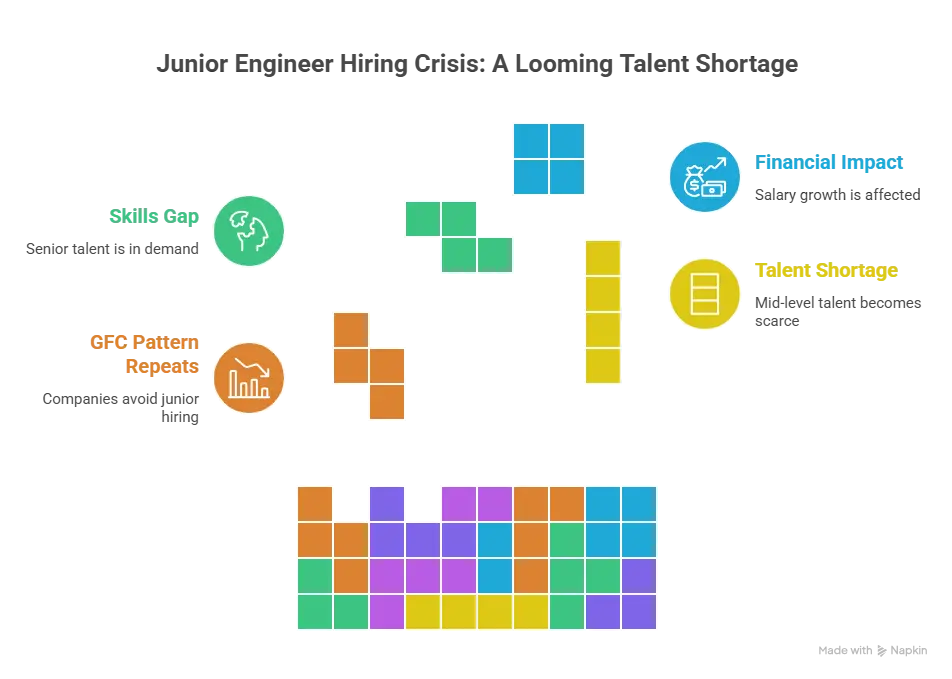
Precision Sourcing, an Australian tech recruitment firm, noted in early 2026 that the difficulty for junior engineers entering the market right now mirrors what happened after the Global Financial Crisis, when companies avoided junior hiring for several years before eventually resuming.
That context is useful. The pattern after the GFC was that companies ran lean on juniors, hit a talent shortage at the mid-level a few years later, and then scrambled to fix it. Several workforce analysts in Australia are already flagging the same risk: cutting junior pipelines now creates a skills gap in senior talent by 2028 or 2030.
That trajectory matters for anyone starting out right now. The companies that are still investing in junior hiring, even in a tough market, will be the ones with the strongest engineering teams in five years. If you want to understand the full salary growth arc from junior to senior, the senior software engineer salary guide for Australia and the mid-level software engineer salary guide map out what that trajectory looks like financially.
The Graduate Hiring Data Is Not All Negative
It is worth being accurate rather than alarmist here. Indeed’s Hiring Lab for Australia reported in April 2026 that graduate job postings rose 6.4% in the March quarter compared with the same period a year earlier. That is a meaningful uptick after two years of decline.
Graduate postings in Australia are still 1.5 times higher than they were in 2019 pre-pandemic levels. The decline from the peak years of 2021 and 2022 has been sharp, but the floor is not as low as some headlines suggest.
The nuance is in the sector breakdown. Postings in occupations highly exposed to AI automation dropped significantly. Postings in occupations where AI augments rather than replaces, including civil engineering, scientific research, and some areas of software infrastructure, held up better.
For junior software engineers, this means the pathway in 2026 runs through specialisation rather than breadth. The full context on what the software engineering job market looks like, including salary benchmarks across Australia, is in the main software engineer salary guide for Australia.

Frequently Asked Questions
-
Is it hard to get a junior software engineering job in Australia in 2026?
Yes, harder than it was two or three years ago. Entry-level postings have declined, competition per role has increased, and some employers have explicitly shifted away from junior hiring due to AI efficiency gains. That said, roles are still available, particularly in enterprise, defence, healthcare, and fintech sectors.
-
What salary should a junior software engineer expect in Australia?
Based on data from Glassdoor (early 2026), the average junior software engineer salary in Australia sits at around AUD 84,350 per year, with the range running from roughly AUD 69,000 to AUD 102,000. PayScale shows a lower median closer to AUD 65,000 to AUD 66,000, which captures a broader mix including smaller firms and regional employers. Sydney and Melbourne consistently pay above the national average.
-
Why are companies hiring fewer junior developers in Australia?
The main driver is AI tooling. Companies using GitHub Copilot and similar tools report meaningful productivity gains that reduce the need for entry-level coding headcount. Some firms have stated directly that the business case for training junior engineers is weaker now than it was before these tools existed.
-
Which programming languages give junior engineers the best chance in Australia?
Python, JavaScript and TypeScript, and cloud-related skills on AWS or Azure are consistently among the highest-demand technical skills for junior roles in Australia right now. Knowing one backend language and one cloud platform well outperforms knowing five things superficially. Our guide on the best programming languages goes deeper on where demand is heading.
-
Can a graduate become a software engineer in Australia without prior industry experience?
Yes, but the pathway has changed. In 2026, the emphasis is on demonstrated work rather than academic credentials alone. Strong personal projects, open source contributions, internship experience, and AI literacy all matter more than GPA or the name of your university. The full career pathway is covered in our guide on how to become a computer programmer.
-
Are graduate tech jobs in Australia recovering?
There are modest positive signs. Indeed’s Hiring Lab reported a 6.4% rise in graduate postings in Q1 2026 compared with the same period a year earlier. It follows two years of decline, and hiring remains well below the 2021 to 2022 peak, but the trend has stopped getting worse and is tentatively improving.
-
What sectors are still hiring junior software engineers in Australia?
Enterprise software, financial services, defence technology, healthcare IT, and government technology projects are the most consistent employers of junior engineers right now. These sectors depend on long-term systems and institutional knowledge, which means they still invest in growing junior talent rather than relying entirely on senior engineers with AI tools.
Share Your Experience
If you are a junior engineer currently job hunting in Australia, or you recently landed your first role, I would genuinely like to hear how it went. What worked, what did not, which sectors or companies surprised you. Drop your experience in the comments below. The more honest accounts we have from people in the market right now, the more useful this resource becomes for everyone who comes after.
How This Article Was Created
The salary data in this article is sourced from Glassdoor (early 2026 figures), PayScale (2026 salary profiles), Indeed Australia (February 2026 job posting data), Levels.fyi (entry-level Australia figures, updated April 2026), and Hays Salary Guide. Hiring trend data references the Jobs and Skills Australia Generative AI Capacity Study (2025), Emanate Technology’s IT Job Market report (April 2026), Indeed Hiring Lab Australia (April 2026), Fuse Recruitment (February 2026), and Precision Sourcing (February 2026).
No salary figures were fabricated or estimated without a cited source. All data reflects the period from late 2025 through mid-2026. This article was written to inform job seekers and is not affiliated with any recruiter, employer, or visa provider.

Shahzada Muhammad Ali Qureshi (Leeo)
I’m Shahzada — a software engineer by education and an SEO professional by trade. I built WhatIsTheSalary.com to go beyond just showing salary numbers — every page is manually researched across sources like BLS, Glassdoor, LinkedIn Salary, and PayScale to give you the full picture in one place. If you found what you were looking for here, that’s exactly the point.