
TL;DR
You do not need another roadmap. You need the right order. Search for the DevOps career path and you will find ten guides that all disagree: learn Kubernetes first, get certified first, learn Python first. Almost none mention what the role actually pays.
So people guess. They study tools in the wrong order, chase certificates they do not need, and lose months before landing a single interview.
This guide fixes that with one clear path from junior to senior, the skills and certifications worth your time, and real pay numbers from IT salary data on WhatIsTheSalary. Follow the order, and you will know your next step.
What Is DevOps and What Does a DevOps Engineer Do?
Who is a DevOps engineer? Someone who works between software developers and IT operations. Instead of developers handing code off for someone else to deploy, a DevOps engineer builds the systems that let both sides release software quickly and safely.
Core responsibilities

Is DevOps a Good Career Path in 2026?
Short answer: yes, with honest caveats. Scroll through Reddit threads asking whether DevOps is a good career and the same themes tend to repeat. People praise the pay and variety, and they complain about on-call duty and tools that change every year. Both sides are fair.
Demand and growth
Are DevOps engineers in demand? The numbers say yes. The US Bureau of Labor Statistics projects 15% growth for software developer roles through 2034, far above the 3% average for all occupations. Spacelift’s 2026 DevOps report adds that DevOps job postings have grown about 18% a year since 2020.
Cloud, microservices, CI/CD, and AI/ML workloads all need people who can run infrastructure reliably.
Is DevOps right for you?
You will probably enjoy it if you like automating repetitive work, solving puzzles under pressure, and working across teams. If you prefer one narrow task and stable routines, a more focused IT role may suit you better.
Pros and cons of a DevOps career
So how is DevOps as a career, day to day? Busy, varied, and rewarding if you like fixing problems.
Prerequisites and Qualifications
Educational background
A computer science degree helps, but it is not required. Many working engineers come from bootcamps, self-study, or IT support. Our guide on becoming a cybersecurity analyst without a degree shows how skills and certifications can stand in for a diploma in a related field.
Entry points
Can a fresher become a DevOps engineer? Yes, but usually in steps. Some industry guides note that DevOps roles often ask for three to four years of prior experience, so most people enter from a neighboring job:
Can you become a DevOps engineer without experience? Without the job title, yes, as long as you show proof. Projects, a home lab, and certifications fill the gap.
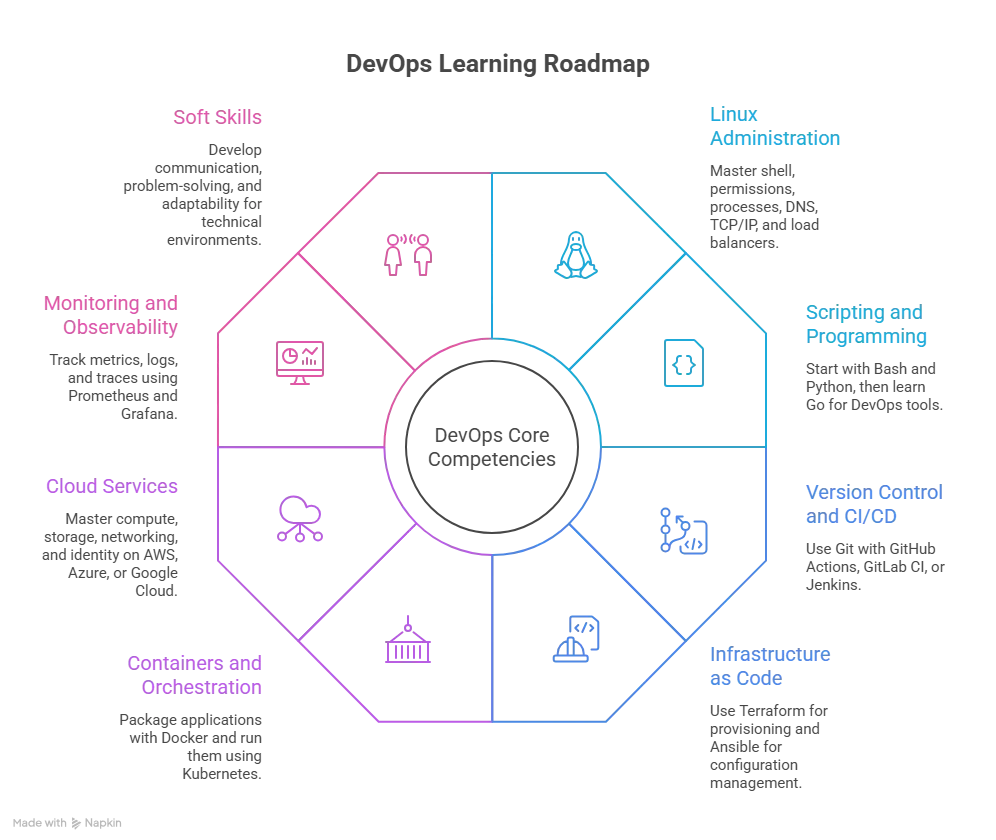
Skills You Need for a DevOps Career
Linux administration and networking
Most production servers run Linux. Learn the shell, permissions, and processes, then DNS, TCP/IP, and load balancers.
Scripting and programming languages
Start with Bash and Python. Go is a useful third language because many DevOps tools are written in it.
Version control and CI/CD
Git is non-negotiable. Pair it with GitHub Actions, GitLab CI, or Jenkins.
Infrastructure as Code and configuration management
Terraform provisions infrastructure and Ansible configures it. Both let you rebuild an environment from a file.
Containers and orchestration (Docker and Kubernetes)
Docker packages applications and Kubernetes runs them at scale. Learn Docker first.
Cloud services and architecture
Pick one provider (AWS, Azure, or Google Cloud) and learn compute, storage, networking, and identity well. The concepts transfer.
Monitoring and observability
Learn metrics, logs, and traces with tools like Prometheus and Grafana.
Soft skills (communication, problem-solving, adaptability)
You will explain outages to non-technical people. Clear writing and a calm head matter as much as any tool.
How to Become a DevOps Engineer: Step-by-Step
1. Build a strong foundation
Get comfortable with Linux, networking, Git, and one scripting language. Expect two to three months of steady practice.
2. Learn the core DevOps tools
Move on to Docker, a CI/CD platform, Terraform, and Kubernetes basics on one cloud.
3. Build projects that prove your skills
Projects beat course certificates in interviews. Deploy a small web app through a CI/CD pipeline to Kubernetes, define the infrastructure in Terraform, and add a monitoring dashboard. Publish it all on GitHub with a clear README.
4. Get certified
Certifications help your resume pass screening. The next section covers the best ones.
5. Gain practical experience
Look for internships or automation tasks at your current job.
6. Start applying for DevOps roles
Apply for junior DevOps, cloud engineer, and system administrator roles.
How long does it take to learn DevOps?
If you already code, six to twelve months of focused study is realistic. Starting from zero, plan for twelve to eighteen months. These are typical estimates, not guarantees.
Best DevOps Certifications
Your DevOps engineer certification path should follow the cloud you plan to work in.
DevOps Career Path by Stage
Entry level: Junior DevOps Engineer and DevOps System Administrator (Years 0 to 2)
Mid level: DevOps Engineer (Years 2 to 4)
- What you do: Design pipelines, manage Kubernetes clusters, write Terraform modules, and join on-call.
- Skills to develop: Infrastructure as Code, observability, security basics, and cost control.
- Signs you’re ready for the next level: Teammates ask for your design advice, and your fixes stop repeat incidents.
- Key milestone: Leading a migration or platform upgrade the business notices.
Senior level: Senior DevOps Engineer (Years 4 to 6)
At this stage, DevOps engineer career growth comes from scope, not tools. You set standards, mentor juniors, and make architecture calls across teams.
DevOps Specializations and Career Branches
First, a note on DevOps specialist vs engineer. An engineer covers the whole delivery pipeline. A specialist goes deep on one slice, such as Kubernetes security. Most careers start broad and narrow over time.
Site Reliability Engineering (SRE)
SREs apply software engineering to operations. They set service level objectives and automate away repetitive toil.
Platform Engineering
Platform engineers build internal platforms so developers can deploy on their own.
AI/ML Infrastructure Engineering
This branch runs GPU clusters and model-serving systems. If you are weighing it against pure data work, the data scientist salary by city breakdown gives context.
Cloud Security Engineering and DevSecOps
These engineers build security into pipelines. The work overlaps with the cybersecurity career path, and the far end of that road is the CISO seat, covered in our CISO salary guide.
Cloud Infrastructure Engineer
You focus on networking, compute, and cost across cloud accounts. The cloud architect vs DevOps engineer salary comparison shows how pay differs if you drift toward architecture.
Automation Architect and Infrastructure Automation Engineer
These roles design the automation frameworks a whole company builds on.
Other roles
Other options include systems engineer, DevOps architect, release manager, test engineer, and DevOps coach. The architect route pays well, as the cloud architect salary in the US numbers show.
Advanced Roles and Leadership
DevOps manager (management track)
Managers hire, coach, plan roadmaps, and own budgets. You write less code and spend more time on people.
Staff and Principal Engineer (individual contributor ladder)
These engineers solve company-wide technical problems without managing people. Pay at this level often approaches architect pay, which the cloud architect salary by experience level data illustrates.
DevOps Engineer Salary and Job Opportunities
Salary by experience level
ERI SalaryExpert’s 2026 data puts the average at about $80,988 for entry level, $114,014 for mid level, and $131,642 for senior roles. Levels.fyi reports a median near $150,000, while Glassdoor and Indeed land around $141,662 and $129,386.
For a government benchmark, the BLS lists a median of $130,390 for computer network architects, the closest category it tracks. For more detail, see our DevOps engineer salary in the US guide and the DevOps engineer salary by experience level page.
Salary by location and role
Location moves pay a lot. Surveys focused on DevOps titles tend to rank California in the top three states. Compare the DevOps engineer salary by city data, and check the cloud architect salary by state figures if architecture interests you.
Who is the highest paid DevOps engineer? Usually a senior, staff, or principal engineer at a large tech or finance company in a major hub. Some salary guides put the top band for DevOps and platform engineers at $200,000 to $350,000 or more in base pay.
What companies look for when hiring
Hiring managers want proof, not buzzwords. Lead your resume with projects and measurable results, such as cutting deploy time or cloud spend.
For interviews, practice troubleshooting a broken Linux service and explaining a CI/CD pipeline end to end.
How AI Is Changing DevOps Work
AI assistants now draft pipeline configs, Terraform code, and runbooks, and AIOps tools help sort noisy alerts. It does not replace judgment. Someone still has to review the output, own the architecture, and secure the system.
DevOps Best Practices to Build Into Your Career
Prioritize automation strategically
Automate tasks that are repeated, error-prone, or slow first. Automating everything at once creates more upkeep than it saves.
Embrace GitOps
With GitOps, Git is the single source of truth for infrastructure. Tools like Argo CD and Flux apply changes and make rollbacks simple.
Implement comprehensive observability
Collect metrics, logs, and traces together so you can find the cause of a problem fast.

Free Resources and Hands-On Training to Support Your Career
You can learn most of this for free. Microsoft Learn, AWS Skill Builder, and Google Cloud Skills Boost all offer free training. For hands-on practice, try Play with Docker and Killercoda, then build a home lab on a free cloud tier.
Frequently Asked Questions
-
How long does it take to become a DevOps engineer?
Most people need 6 to 18 months of study to reach a junior role. Senior level usually takes four to six years of work.
-
Do you need a degree to become a DevOps engineer?
No. A degree helps, but employers weigh projects, certifications, and hands-on skills heavily.
-
Is coding required for DevOps?
You need scripting at minimum. Bash and Python are enough to start.
-
What is the difference between DevOps and SRE?
DevOps is a culture of delivering software faster. SRE focuses on reliability, using service level objectives and error budgets.
-
Can beginners get into DevOps?
Yes. Build projects and aim for a junior or adjacent role first.
-
Is DevOps stressful?
It can be, mainly because of on-call duty. Good automation and clear runbooks help.
Conclusion
The DevOps engineer career path rewards people who stay curious and build things. Start with Linux, Git, and one cloud, prove your skills with projects, then add certifications and move up through the stages.
Pick a direction at senior level. The demand is real, so build your first pipeline this week.

Shahzada Muhammad Ali Qureshi (Leeo)
I’m Shahzada — a software engineer by education and an SEO professional by trade. I built WhatIsTheSalary.com to go beyond just showing salary numbers — every page is manually researched across sources like BLS, Glassdoor, LinkedIn Salary, and PayScale to give you the full picture in one place. If you found what you were looking for here, that’s exactly the point.