
TLDR
Most people who search for how to start transcription work from home give up before they earn a single paid file. It’s rarely because the work is too hard. They apply to fifteen sites, fail half the tests, and decide the whole thing is a scam.
The real problem is missing information. Nobody explains that most platforms test you before you earn, that pay is quoted per audio hour, or that a one-hour recording can take three hours to finish. Without those details, a $45 rate feels like a promise and quietly turns into about $15 an hour.
The fix is simpler than the advice out there. Pick two or three beginner platforms, treat every test as a real job application, and track your actual hourly rate from week one. I laid out that exact path with sourced 2026 pay figures in salary and career guides at WhatIsTheSalary, where you can also compare pay across other remote careers.
What Transcription Work From Home Looks Like
Transcription is one of the few remote jobs where you can start earning without a degree, a portfolio, or a resume full of tech credentials. You listen to audio, type what people say, and send back a clean, accurate file. Simple on paper. The details decide whether it pays well.
Clients include law firms, hospitals, podcast networks, universities, market research firms, and companies that record their meetings. Plenty of them still need a human to check what software produced, because machine drafts often miss names, jargon, and overlapping speech.
Three Types of Transcription Work
Not all transcription is the same. The category you pick shapes your pay, your training time, and how long it takes to land your first accepted application.
General Transcription
This is where most people start. You handle interviews, webinars, focus groups, podcasts, and video content. No industry knowledge is needed, and most beginner platforms hire for this type of work. It builds the speed and accuracy every other niche depends on.
Legal Transcription
Legal work covers depositions, court hearings, and attorney dictation. The pay is higher, with one 2026 career guide placing it at $45 to $80 or more per audio hour. You need comfort with legal terms and formatting, and some clients ask for AAERT certification. I would aim for this after six to twelve months of general work.
Medical Transcription
Medical transcription has changed the most. Many roles now involve editing a speech recognition draft instead of typing from scratch. Formal training typically runs six to eighteen months and costs roughly $1,500 to $3,000, based on 2026 program listings.

Skills You Need Before You Apply
You don’t need a long list of credentials. You do need a few skills that platforms test within your first week.
Transcription doesn’t ask for a degree, which is the same reason it appears on so many lists of no-degree remote work. If you’re weighing a similar route into tech, the guide on how to become a cybersecurity analyst without a degree shows what hiring managers look for when formal credentials are thin.
Equipment Setup Without Overspending
Startup cost is low, and most people already own what they need.
A foot pedal helps once you’re working consistently. The Infinity IN-USB-2 is the model people mention most, and UK listings put it at roughly £70 to £90. Buy one after your first month, when you know your pace and whether you’ll stick with it.
How Much Transcription Pays in 2026
Most guides mislead here. They quote a rate per audio hour and let you assume it’s your hourly pay. It isn’t. A one-hour recording often takes two to four hours to transcribe accurately, so your real hourly income is lower than the headline number.
ZipRecruiter reported an average of $22.63 per hour for remote transcription work as of June 14, 2026. Indeed’s average for transcriptionists, as cited by TranscribeAnywhere, sits closer to $26.38 per hour. Those are useful anchors, though they blend beginners with specialists.
| Work type | Published pay | Source | What it means |
| Remote transcription (typical range) | $15 to $30 per hour | ZipRecruiter, 2026 | Blended across experience levels |
| Remote transcription (average) | $22.63 per hour | ZipRecruiter, June 14, 2026 | Useful midpoint for planning |
| Legal transcription | $45 to $80+ per audio hour | 2026 career guide benchmark (Gerald) | Needs legal terms, often certification |
| Medical transcription | $15 to $30 per hour | 2026 career guide benchmark (Gerald) | Usually editing AI drafts, training required |
Here’s the math that matters. If a platform pays $45 per audio hour and a recording takes you three hours, your effective rate is $15 per working hour. The same file at $80 per audio hour works out to about $27. Speed and accuracy move that number more than the headline rate does.
Pay per minute is also platform specific. One 2026 roundup puts Rev between $0.30 and $1 per audio minute, depending on the work. Check each platform’s transcriber page directly. For a sense of how pay scales across remote tech roles by location, the data scientist salary by city guide offers a useful comparison point.
Platforms Worth Applying To First
Skip the lists of twenty sites. A focused shortlist works better, and every platform makes you pass a test first.
Apply to two or three at a time. Most platforms require a test, and doing three tests well beats doing fifteen badly.
Step by Step: Your First Week
Step 1: Test Your Typing
Run a free test on Typing.com or TypingTest.com. If you’re under 60 words per minute, spend a few days on drills before applying, since your speed decides how much you earn per audio hour.
Step 2: Set Up a Simple Workspace
Pick a quiet room, plug in your headphones, and install Express Scribe or open oTranscribe. Test the playback controls once before touching a real file.
Step 3: Apply to Two or Three Platforms
Take each test seriously. The test is often the only real screening step, so accuracy there matters more than speed. For a broader look at how skills assessments fit into hiring, the guide to the US tech interview process explains what evaluators usually check, and the logic carries over.
Step 4: Protect Your Quality Score
Start with short, clean files. Every platform tracks accuracy, and that score decides which work you’re offered next. Rushing a handful of early files can cost you access to better pay for months.
Step 5: Track Your Real Hourly Rate
After two weeks, add up the hours you actually spent and divide your earnings by that number. If you’re below your target, change your file mix or your workflow, not just your effort.
Where AI Fits Into Transcription Work Now
Most guides avoid this, so I’ll be direct. AI tools such as Whisper, Otter.ai, and Descript now produce a first draft on clean audio, and many platforms expect you to start from that draft and correct it.
This changes the job without removing it. AI still struggles with heavy accents, overlapping speakers, poor recordings, and specialized vocabulary in legal and medical files. Those are the files clients pay for, and they’re where a skilled editor earns the higher rate.
Presenting Yourself When You Move to Direct Clients
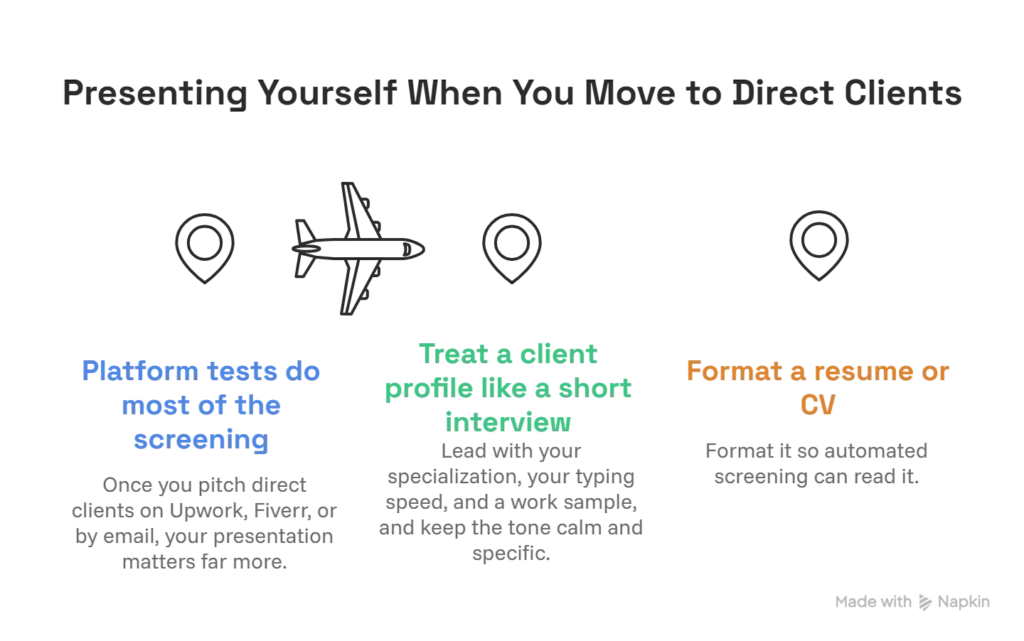
Platform tests do most of the screening. Once you pitch direct clients on Upwork, Fiverr, or by email, your presentation matters far more.
Treat a client profile like a short interview. Lead with your specialization, your typing speed, and a work sample, and keep the tone calm and specific. The guide on what to wear and say in a US job interview covers the same first impression habits that build trust with a client.
If you send a resume or CV for remote contract work, format it so automated screening can read it. The ATS filters in US job applications guide explains what gets filtered out, and the US resume vs. CV breakdown shows what employers read first.
Moving From Beginner Rates to Higher Pay
Growth in this field follows a pattern: accuracy first, then volume, then specialization.
In months one to three, focus on your quality score and steady turnaround. Don’t chase volume at the cost of accuracy. In months three to six, you’ll have enough history to apply to higher-paying platforms like Scribie or Daily Transcription and start bidding on Upwork.
Specialization is the biggest lever. Legal transcription with AAERT certification, or medical transcription backed by AHDI credentials, moves you into a different pay range. You see the same pattern in tech, where a longer ladder rewards certifications stacked on real experience. The cybersecurity career path shows how that stacking works in practice.

Common Mistakes New Transcriptionists Make
Frequently Asked Questions
-
Do I need a degree to do transcription work from home?
No. General transcription doesn’t require a degree. You need to pass the platform’s transcription and grammar test. Medical and legal specialties have their own certification tracks, and you can pursue those after you start working.
-
How fast do I need to type?
Most platforms look for around 60 words per minute with high accuracy. Aim for 75 to 80 before you apply, because speed directly affects your effective hourly pay.
-
How long does it take to get your first transcription job?
It depends on the platform and your test results. Some beginner guides report first work within one to two weeks of applying. Apply to two or three platforms at once so one slow review doesn’t stall you.
-
Is transcription work full-time or part-time?
Both are possible. Most beginner platforms let you choose files whenever you want, with no minimum hours. Work availability fluctuates, so keep a second platform active as backup.
-
Will AI replace transcription jobs?
Not entirely. AI handles clean audio reasonably well, but accents, overlapping speech, and legal or medical terminology still need a human. The job is shifting toward editing AI drafts rather than typing from scratch.
-
How do I spot a fake transcription job?
Walk away from any listing that charges an application fee, asks you to buy a starter kit, or offers to sell you an approved account. Legitimate platforms pay you for work, not for access.
Share Your Experience
If you’ve already started transcription work, or you’re deciding whether to try, I’d like to hear from you in the comments. Which platform gave you your first file, what the test felt like, and what you wish you’d known on day one? Your story might be the detail the next beginner needs.
How This Article Was Created
Pay figures come from ZipRecruiter (June 2026), a 2026 career guide benchmark from Gerald, and Indeed averages as cited by TranscribeAnywhere (July 2026). Platform pay rates come from 2026 roundups and were not checked against each platform’s live transcriber page, so confirm them before you apply. No figures were fabricated. The only calculations are simple arithmetic shown in the text. This article was written to inform people exploring transcription as a remote income option, not to recruit for any platform or service.

Shahzada Muhammad Ali Qureshi (Leeo)
I’m Shahzada — a software engineer by education and an SEO professional by trade. I built WhatIsTheSalary.com to go beyond just showing salary numbers — every page is manually researched across sources like BLS, Glassdoor, LinkedIn Salary, and PayScale to give you the full picture in one place. If you found what you were looking for here, that’s exactly the point.