TLDR
How to Become a Substitute Teacher in the US sounds simple until you start searching. One guide says a high school diploma is enough. The next demands a bachelor’s degree and a state permit. You lose weeks on the wrong paperwork, and you still don’t know what the job pays.
The confusion has a clear cause. About 40% of states require a degree or college credits, according to k12.careers, and the rest don’t. Rules also change by district, so no single checklist fits everyone.
So I matched state requirements with 2026 pay data in one place. Follow the five steps below, then compare your offer with the real salary data on WhatIsTheSalary before you accept your first assignment.
What a Substitute Teacher Actually Does
A substitute teacher covers the classroom when the regular teacher is out. You follow the lesson plan, take attendance, manage students you have never met, and leave notes for the teacher who returns.
Short-term subs cover a day or a few days. Long-term subs cover weeks or months. Capella University’s 2026 guide says long-term assignments are where districts most often ask for a bachelor’s degree.
Who This Job Fits, and Who It Does Not
Subbing rewards patience, quick thinking, and clear communication. WeAreTeachers puts patience, empathy, and a real interest in kids at the top of the list. It also asks you to accept unpredictable, part-time style work, since your calendar depends on teacher absences.
If you need a guaranteed weekly paycheck, this may frustrate you. If you want flexibility, a way into schools, or income beside another job, it fits well.

How to Become a Substitute Teacher in the US: 5 Steps
Step 1: Check Your State and District Rules
Start with your state department of education, then the HR page of the district you want. Write down every document each one asks for before you apply anywhere.
Step 2: Meet the Minimum Education Requirement
About 40% of states require a degree or college credits, according to k12.careers. The rest accept a high school diploma or GED plus a background check.
New Jersey asks for 60 semester credit hours from a regionally accredited school (EducationDegree.com). SubCertify’s 2026 guide says a bachelor’s degree in any field qualifies you for most positions in most states.
Step 3: Clear the Background Check
Every state requires one, and many add fingerprinting and child-safety clearances. Delaware also asks for a TB test, per Kelly Education. Start this first, since nothing else moves until it clears.
Step 4: Get the Permit or License if Your State Requires One
California asks for a 30-Day Substitute Teaching Permit from the Commission on Teacher Credentialing, with transcripts and fingerprints. Illinois issues a Substitute Teaching License. Arizona issues a standard or emergency substitute certificate.
Ohio offers a one-year or five-year substitute license, and neither renews (EducationDegree.com). Check the expiry date before you plan around it.
Step 5: Apply and Attend Orientation
You have three routes. Most districts run their own substitute pool, so search the district site for “substitute.” Staffing companies such as ESS and Kelly Education handle hiring for some districts. EdJoin lets you build one profile and attach your documents once.
Some districts also ask for CPR or first aid training and letters of recommendation, per WeAreTeachers. Line up two references early so they do not slow you down.
After orientation, you take assignments through an automated system by phone or app. In Montgomery County, Maryland, subs pick their own schedule and preferred schools. Florida requires a district-provided training program before you start, per SubCertify.
Substitute Teacher Requirements by State
Here is a quick comparison of seven states, using the sources I found.
| State | Minimum education | Permit or license | Reported annual pay |
| California | Bachelor’s degree | 30-Day Substitute Teaching Permit | $38,660 (Zippia) |
| Arizona | Bachelor’s degree | Standard or emergency certificate | $33,237 (Zippia) |
| Washington | Bachelor’s plus teacher prep program | Teacher certificate | $44,230 (TeacherCertificationDegrees) |
| Hawaii | Bachelor’s degree | TB test, plus substitute course or teacher training | $47,940 (TeacherCertificationDegrees) |
| Wyoming | High school diploma or GED | US and Wyoming Constitution exams | $33,060 (TeacherCertificationDegrees) |
| Kentucky | Bachelor’s degree | Substitute license | $20,880 (TeacherCertificationDegrees) |
| New Jersey | 60 semester credit hours | Substitute credential | No reliable figure found |
Pay figures come from different datasets and years, so compare within a row, not across rows. Confirm every rule with your state department of education before you apply.
Can You Become a Substitute Teacher Without a Degree?
Sometimes. Wyoming accepts a high school diploma or GED, though you must pass the US and Wyoming Constitution exams and complete in-service training unless you hold an associate degree. Delaware needs a diploma or equivalent, age 18 or older, a background screening, and a TB test.
The bar is rising, though. SubCertify says an associate or bachelor’s degree is increasingly expected for long-term and middle or high school assignments. Even 60 college credits opens New York and New Jersey.
Skills-first hiring shows up outside teaching too. I covered the same idea in a guide on becoming a cybersecurity analyst without a degree.
Private Schools Hire Substitutes Too
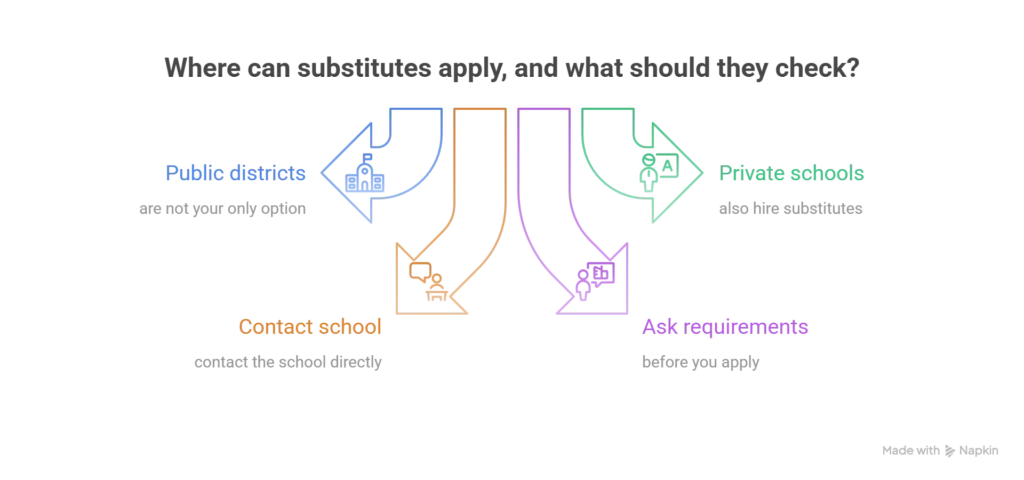
Public districts are not your only option. Pennsylvania’s education department notes that private schools also hire substitutes and may set different requirements, so contact the school directly.
Ask what they require before you apply. Their rules can differ from the local district’s, which changes how quickly you can start.
Substitute Teacher Salary in 2026: What the Data Says
Every platform reports a different number, and the gap is wide enough to confuse anyone. Here is what I found:
The spread exists because each site builds its number differently. Indeed draws from job postings. Zippia blends BLS data with posted salaries. Hourly figures also treat part-day and full-day work in different ways.
Location moves the number more than anything else. Zippia ranks Alaska at $39,750, California at $38,660, and Oregon at $37,742. Indeed shows $16.09 an hour in Texas and $23.83 in Virginia. Geography shapes pay in every field, which I showed in data scientist salary by city.
Zippia’s February 2026 update puts the average substitute salary at $32,904, against a national average near $44,225 for all jobs. That gap explains why many subs look at related roles. Zippia’s ranking lists student teacher at $59,035 and summer school teacher at $52,828, so adjacent school jobs can pay more.
For scale, the pay tiers in the CISO salary guide sit far above these figures. That is why many career changers treat subbing as a stepping stone, not a destination.
What a Full Year of Subbing Looks Like in Dollars
A daily rate is not an annual income. Indeed lists a common substitute daily rate of $157.76, with postings from $60 to $400 a day (January 2026 data).
Many states set the school year near 180 days. Working every single day at $157.76 would earn about $28,400. You will not get called every day, so treat that number as a ceiling.
Local examples show the range. EducationDegree.com lists an average of $109 a day in Missouri. Leander ISD in Texas announced increased 2026-2027 substitute pay rates, so check each district’s current pay sheet before you trust last year’s number.
Ask each district whether long-term assignments change your rate or benefits, since policies differ.
How to Get Hired Faster: Resume, ATS and Interview
Use a US-style resume, not an academic CV. This breakdown of US resume vs CV shows what employers expect.
Many large employers scan applications with software, so keep headings plain and borrow keywords from the posting, such as classroom management and student supervision. I explained how this works in ATS filters in US job applications.
If a district interviews you, expect questions about disruptive behavior, engagement, and following the regular teacher’s rules. Teal’s interview guide also lists last-minute assignments. Practice with these behavioral interview questions and answers, and use the STAR format.
Dress business casual or better. My guide on what to wear and say in a US job interview covers the details. If you come from tech, the structure will feel familiar from the US tech interview process, minus the coding rounds.
Three mistakes I would avoid:
How to Get Called Back: What Schools Want From Subs
Getting hired is step one. Getting asked back is what builds your income. Education Week covered a review of 29 studies on substitute experiences, and one finding stands out. Subs often feel unwelcome or left out by school staff, and many hesitate to ask questions in case they look unprofessional.
You can lower that friction. Arrive early, find the office contact, and ask for the lesson plan and bell schedule before students walk in. Education Week also shared a simple opening move: let students ask you a few questions about your pets, family, or hobbies at the start of class. It builds trust fast.
Finish by leaving clear notes for the regular teacher. I would treat that note as your résumé for the next call.
Substitute Teaching as a Path Into Full-Time Teaching
Subbing lets you test grade levels, meet principals, and log classroom time before you commit to a teacher preparation program. American College of Education advises taking long-term sub roles and showing progress toward licensure.
BLS data cited there projects about 61,100 openings between 2024 and 2034. Stepping-stone roles work this way in other fields too, as I mapped out in the cybersecurity career path.
Frequently Asked Questions
-
Do you need a degree to be a substitute teacher?
Not always. About 40% of states require a degree or college credits, per k12.careers. The rest accept a high school diploma or GED plus a background check. Districts can set higher bars.
-
Do you need a license to substitute teach?
It depends on the state. California, Illinois, and Arizona require a permit, license, or certificate. Other states let you start with a background check and proof of education, according to Capella.
-
How old do you have to be?
You must be at least 18, per Kelly Education. Some districts set the minimum higher.
-
How much do substitute teachers make per day?
Indeed lists a common daily rate of $157.76, with postings from $60 to $400. Your state and district drive the gap.
-
Can you substitute teach without teaching experience?
Yes in many places. Most districts require screening and orientation, not prior classroom experience. Long-term roles are stricter.
-
Can substitute teaching lead to a full-time job?
It can. You build classroom hours and district contacts, and you can test your fit. You still need the credentials your state requires for a full teaching license.
-
Is substitute teaching worth it financially?
As a full-time income, it is tight in most states. Zippia’s average of $32,904 sits well below the national average for all jobs. As a flexible first step into schools, many people find it worth the trade.
Share Your Experience
If you have subbed, I would like to hear how it went. Which hiring route worked for you, and what surprised you on day one? Leave a comment. Your story will help the next reader more than any guide.
How This Article Was Created
I drew on Zippia, PayScale, Indeed, Salary.com, ZipRecruiter, BLS data cited by American College of Education, and the nine ranking guides named above. The data covers listings updated between January and November 2026.
I did not make up any figures. Where a source was missing, I said so. This article informs job seekers and does not recruit for any district or agency.

Shahzada Muhammad Ali Qureshi (Leeo)
I’m Shahzada — a software engineer by education and an SEO professional by trade. I built WhatIsTheSalary.com to go beyond just showing salary numbers — every page is manually researched across sources like BLS, Glassdoor, LinkedIn Salary, and PayScale to give you the full picture in one place. If you found what you were looking for here, that’s exactly the point.