
TLDR
Your neighbor just paid someone to mount a TV, and the job took under an hour. You own the drill, the level, and a free Saturday. So why wasn’t that someone you?
How to start a handyman side job is not really a skills problem. The real blockers are not knowing what to charge, which jobs need a license, and who will hire you first. Most beginners guess at prices, undercharge, and quit by month two.
Here is the fix. Price from real numbers, stay under your state’s per-job cap, and bundle small tasks into one visit. Self-employed handymen bill $60 to $90 an hour in 2026, and I’ll walk you through every step. If you like seeing what jobs really pay across careers, our homepage is a good place to compare.
Why a Handyman Side Job Works in 2026
I keep meeting people with a garage full of tools and a neighbor asking for help who still have not charged a dollar. The usual reason is “I do not know where to start.” This guide fixes that.
A handyman side job is one of the cheapest ways to add income. You need a short list of skills, a modest tool kit, and the habit of showing up on time. A degree is not part of the deal.
Better still, the numbers are easy to check. Everything below comes from 2026 pricing and pay data, and I name each source so you can compare it against what handymen charge in your own town.
Step 1: List What You Can Do Well
A quick test helps: if you could teach the job to a friend in ten minutes, it belongs on your list.
Write down every repair you have finished confidently. Good starter jobs are furniture assembly, TV mounting, door swaps, drywall patches, fixture installs, caulking, and gutter cleaning. They are low risk and quick to price.
Leave out electrical panels, structural work, HVAC, and anything that needs a permit. One botched job in a stranger’s home costs more in reputation than a declined job ever will.

Step 2: Check Your State’s License Rules
Handyman licensing is not federal. It changes by state and often by city. Many states use a per-job dollar cap that separates handyman work from contractor work. Examples reported for 2026:
A business license registers your business. A contractor license lets you do regulated trade work. Most beginners need only the first. Spend 30 minutes on your state contractor board site and the SBA licensing page before you quote anything.
Step 3: Build a Tool Kit for Under $1,500
A mid-range kit covers most jobs. Budget $500 to $1,500 for a cordless drill and driver, circular saw, hammer, pry bar, 4-foot level, tape measure, screwdriver set, socket set, utility knife, stud finder, and safety gear. Buy specialty tools only when a paid job calls for one.
Step 4: Price So You Actually Profit
Undercharging is the top beginner mistake. Your rate has to cover self-employment tax (15.3%), fuel (the 2026 IRS mileage rate is 72.5 cents a mile), tools, insurance, and unpaid admin time.
Here is how the 2026 numbers stack up, from employee pay to what homeowners see:
| Pricing Item | 2026 Range | Source |
| Employee average hourly pay | $25.49 | ZipRecruiter, June 2026 |
| BLS median, maintenance and repair workers | $23.38 | BLS, 2024 data |
| Entry level employee (0 to 2 years) | $18 to $25 | Housecall Pro, 2026 |
| Experienced employee (5+ years) | $35 to $50+ | Housecall Pro, 2026 |
| TaskRabbit average per hour | About $38 | TaskRabbit, March 2026 |
| Self-employed handyman per hour | $60 to $90 | Getjobber, 2026 |
| What homeowners pay per hour | $45 to $125 | Instaservice, July 2026 |
| Minimum service call | $100 to $200 | Instaservice, July 2026 |
| Half-day rate | $250 to $500 | Instaservice, July 2026 |
| Full-day rate | $450 to $900 | Instaservice, July 2026 |
Use a flat rate for predictable work like TV mounting and an hourly rate when scope is unclear. Always add a two-hour minimum or a $100 to $200 service call so a short job still pays for the drive.
Step 5: Get Insured Before Job One
General liability insurance covers property damage and injury on a job site. One dropped ladder through a glass table can erase months of earnings. Premiums depend on your state and services, so collect two or three quotes. A surety bond is separate and runs about $100 to $300 a year. Landlords and property managers often ask for proof, so a clear “yes” wins jobs.
Step 6: Land Your First Clients for Free
Text your first 20 contacts: neighbors, coworkers, family, and anyone who rents out property. Be specific, like “I am taking door repairs, drywall patches, fixture installs, and small punch lists.” Vague offers get forgotten. A list of tasks reminds people of the job they keep putting off.
After that, try these channels:
Photograph every job before and after, then ask for a review the same day. Reviews are what convince strangers to pick you.
Step 7: Bundle Small Jobs Into One Visit
One small task rarely justifies the trip. Three or four related tasks do. Ask every client, “Anything else on your list?” Most have a stack of small jobs and are glad to clear them in one go. A drywall patch, a door hardware swap, and a TV mount make a good single visit.
How Much Can You Realistically Earn?
Employees average $53,009 a year, or $25.49 an hour (ZipRecruiter, Getjobber, 2026). Self-employed handymen billing $60 to $90 an hour for 30 to 40 hours a week can gross $53,000 to $135,000. Side hustlers work far less, so here is the weekend math at $75 an hour:
Subtract tax, insurance, tools, and mileage to get take-home. If you like comparing career paths, our look at cybersecurity analyst jobs without a degree and the full cybersecurity career path shows how skill-based pay scales. For a view from the top of a ladder, see our CISO salary guide.
Taxes on Your Handyman Income
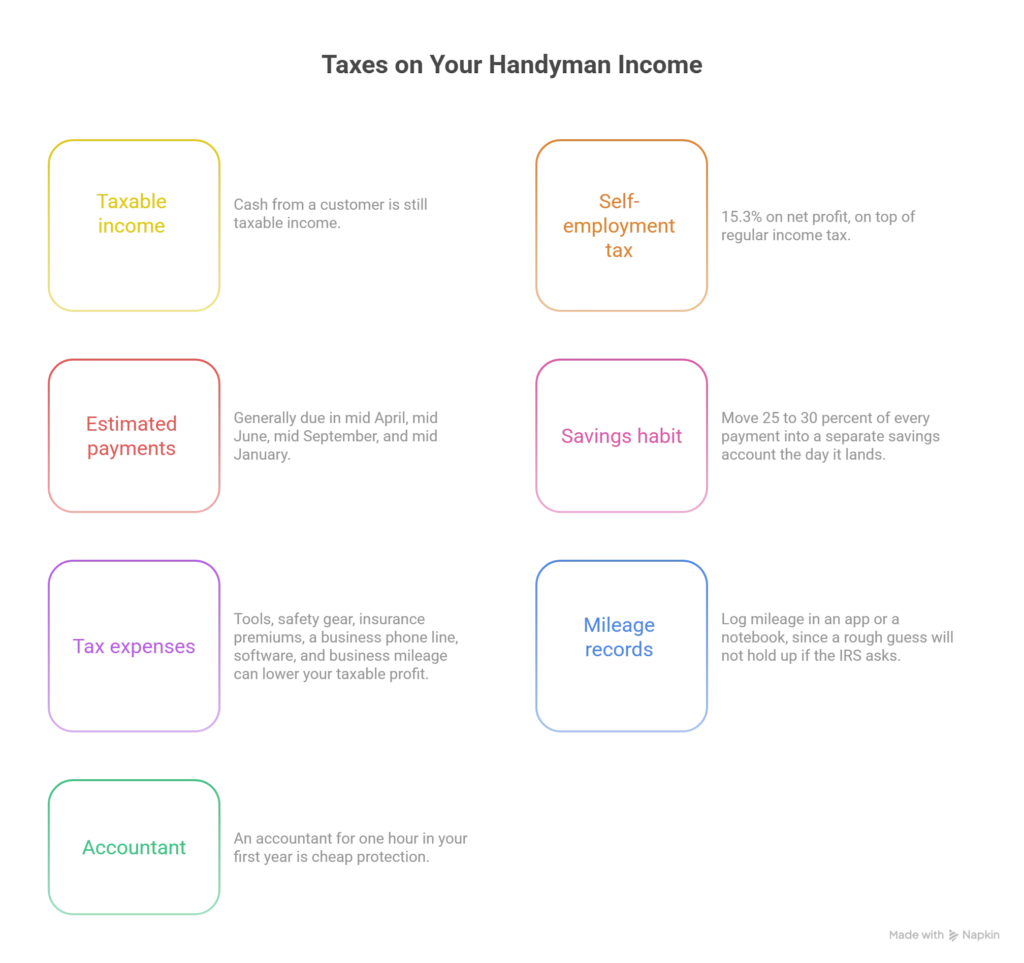
Most guides skip this, and it is where side hustlers get burned. Cash from a customer is still taxable income. You owe self-employment tax of 15.3% on net profit, on top of regular income tax, and the IRS expects estimated payments during the year instead of one bill in April.
Quarterly estimated payments are generally due in mid April, mid June, mid September, and mid January. A simple habit helps: move 25 to 30 percent of every payment into a separate savings account the day it lands. Adjust that number once you see your real tax bracket.
Track every expense from the first job. Tools, safety gear, insurance premiums, a business phone line, software, and business mileage can lower your taxable profit. Log mileage in an app or a notebook, since a rough guess will not hold up if the IRS asks. An accountant for one hour in your first year is cheap protection.
What Pushes Your Rate Higher
Specialize
General handymen compete on price. Specialists win on trust. Smart home setup, pre-sale punch lists for realtors, grab bars and accessibility work, and Airbnb turnovers all support premium rates. Tech skills help here, and our guide to cloud bootcamps versus other routes shows how upskilling changes earning power.
Collect reviews
Dozens of five-star reviews let you hold a higher price without pushback. Ask right after the job, while the client is still pleased with the result, and send a direct link so leaving a review takes ten seconds.
Add credentials
EPA lead-safe certification is needed in pre-1978 homes, and OSHA 10 plus state registrations open jobs unlicensed operators cannot touch. Location also moves pay, which our data scientist salary by city breakdown illustrates well.
When the Side Job Becomes a Business
The signal is simple: you are turning work down, or side income nears your day job take-home. Then register an LLC ($50 to $500 by state) and get a free EIN from the IRS to open a business bank account.
Property managers and other commercial clients judge you fast. Our advice on what to wear and say in a U.S. job interview carries over to client pitches.
Mistakes That Stall New Handymen
If you ever pitch a larger company, our overview of the U.S. tech interview process shows how formal evaluations work.
Job Hunting and Side Gigging at the Same Time
List the work as self-employment with outcomes, like “Completed 40+ residential repair and install jobs with a five-star Google rating.” That reads well to hiring managers. If applications vanish, learn how ATS filters work in U.S. applications, and check the difference between a U.S. resume and a CV.
Your First 90 Days: A Simple Plan
Here is the timeline I would follow if I were starting this week.
That last review is the step beginners skip. Two jobs that look the same on paper can pay very differently once you count driving and materials runs, and your own records will show you which ones deserve your weekends.
Frequently Asked Questions
Do I need a license to start a handyman side job?
Usually not for small jobs. Most states set a cap, often $500 to $3,000 per project, and regulated trades like plumbing and electrical always need a license. Check your state board first.
How much should a beginner handyman charge?
Start around $50 to $70 an hour with a two-hour minimum, then raise rates as reviews build. National 2026 data shows self-employed handymen at $60 to $90 an hour.
Which handyman jobs pay the most?
Smart home installs, realtor punch lists, accessibility upgrades, and deck staining. They carry high perceived value and bundle easily.
Can I start with no experience?
Yes, if you stay inside your skill level. Begin with assembly, mounting, and hardware installs, and shadow an experienced handyman to learn faster.
Do I need insurance?
Yes. General liability covers damage and injury on the job, and many landlords require proof before hiring.
Final Thought
Know your skills, check your state rules, price with a minimum, get insured, and ask your network for the first jobs. The people who earn well are not the most skilled. They are the ones who show up, do what they quoted, and ask for the review. You can book your first paid job this weekend.
How This Article Was Created
I researched this in November 2026 using ZipRecruiter (June 2026), Getjobber (March 2026), Housecall Pro, TaskRabbit, Instaservice (July 2026), and the Bureau of Labor Statistics, plus 2026 state licensing guides. I did not invent any figures. Rates and rules change, so confirm local requirements before you start. This article is meant to inform, not to advertise any platform.

Shahzada Muhammad Ali Qureshi (Leeo)
I’m Shahzada — a software engineer by education and an SEO professional by trade. I built WhatIsTheSalary.com to go beyond just showing salary numbers — every page is manually researched across sources like BLS, Glassdoor, LinkedIn Salary, and PayScale to give you the full picture in one place. If you found what you were looking for here, that’s exactly the point.